Kit’s Crit: The Dovekeepers (Alice Hoffman)

Dovekeepers

The Dovekeepers (New York: Simon & Schuster, 2011) tells the tragic story of the Siege at Masada in 70 CE, when 900 Jews were trapped on a mountain in the Judean desert surrounded by an army of hostile Roman soldiers.  After many months of resistance the rebels chose to commit mass suicide rather than surrender into slavery.  Only 2 women and 5 children survived.  They gave their testimony to a scholar named Flavius Josephus.  Alice Hoffman then turned their extant accounts into this epic historical fiction.

The Dovekeepers follows the lives of four women: Yael, the daughter of an assassin; Revka, a baker’s wife who lost her daughter in a brutal Roman attack; Aziza, who was raised as a male warrior; and Shirah, “The Witch of Moab.”  These four women arrive at Masada on very different paths, yet they all become dove keepers at the fortress.  Shirah and Yael survive the final massacre.

Hoffman’s lengthy book is vivid and powerful, with a dramatic mix of magic and Judaism that some readers may find offensive.  And some of the supernatural elements, like the cloak of invisibility, stretch the bounds of belief.  Nevertheless, the book resonates with the strength of the human spirit in the face of adversity, and is a wonderful reminder of courage, sacrifice, and fortitude.

I found Shirah the most compelling character.  She is an Alexandrian wise woman with uncanny insight, gifted in magic and medicine.  Shirah was trained by an Egyptian priestess and passes on some of her skills to Yael.  Her bravery helps the few survivors to escape through their underground cave system – the final proof of her resilience, adaptability, and cunning powers.

The Dovekeepers is a great Book Club selection, generating a lot of insightful discussion.  But its length and density makes it more demanding than some other popular choices.

Copyright © 2022 | KitPerriman.com | All Rights Reserved

Kit’s Crit: The House of the Spirits (Isabel Allende)

Allende Isabel Allende’s The House of the Spirits is my first encounter with Latin American magical realism (New York: Random, 2005).  This epic saga follows three generations of a Chilean family – headed by the determined patriarch Esteban Truebas – as they experience joy, tragedy, struggle, rebellion, and political turmoil, in a world where the supernatural mingles alongside reality.

The House of the Spirits contains magic, ghosts, poison, and demonic possession, and it functions as an allegory of the South American world where Allende grew up.  It is a novel designed to “reclaim the past” and “overcome the terrors” of Chilean history (433).

Allende successfully employs symbolism, mysticism, and nationalism in a vivid drama of political turmoil and feminist rebellion.  And while the novel itself does not rank as great literature, it is an excellent example of lush storytelling and descriptive writing – a tale that resonates with the poetic musicality of the Latino language.

I would recommend The House of the Spirits to those readers seeking a unique, well-crafted, multi-cultural experience. 

Copyright © 2022 | KitPerriman.com | All Rights Reserved

Kit’s Crit: The Other Boleyn Girl (Philippa Gregory)

Gregory

On my first reading of The Other Boleyn Girl in 2001, I was impressed by Philippa Gregory’s bravery in writing against the popular romantic image of the Tudor queen as a much-maligned victim.  I re-read the book again this past week as part of my research into medieval witchcraft, and still maintain this is one of the finest examples of historical fiction in the genre.

Gregory plays the devil’s advocate by posing the question: What if Anne Boleyn really was guilty of the charges brought against her?  She then weaves a plausible explanation of the young woman’s dangerous rise to power, a gamble that ultimately cost her life.  The story is told through the eyes of the other Boleyn girl at court, her sister Mary.  And although British historian David Starkey claims there are only “four known facts” about Mary Boleyn, and that this therefore amounts to “one fact per seventy-five pages,” Gregory does a splendid job of recreating an authentic version of the Tudor court from numerous other sources.  There are, fortunately, many more extant facts regarding Anne and Henry!

Gregory’s Queen Anne is not an endearing character, but then everything said about her comes from the rival sister’s lips – one of the women she ousted from the king’s bed.  Anne is portrayed as ambitious, vain, single-minded, selfish, ruthless, callous, manipulative, and amoral.  Yet she is also intelligent, artistic, fashionable, and fun.  She is not a practicing witch – though she does enchant Henry and all those around her – but when placed in a desperate situation she turns to a local wise woman for help.  As the king is aging and impotent, when Anne needs a son to secure the throne her brother George steps in as a replacement.  And she may or may not have poisoned some of her enemies.

The Other Boleyn Girl strips away the traditional glamor of court, presenting a much more realistic insight into the fragile and perilous lives of the youngsters groomed as bargaining chips by their ambitious families.  It also highlights the differences between those born high and low, and how real happiness lies in the simple pleasures of life.  The characters are engaging and interesting – even as they descend into strange, dark places.  And the psychological explanations offered for Anne Boleyn’s criminal behavior are fascinating, thought-provoking, and plausible – even if factually untrue.

A five-star read!

Copyright © 2022 | KitPerriman.com | All Rights Reserved
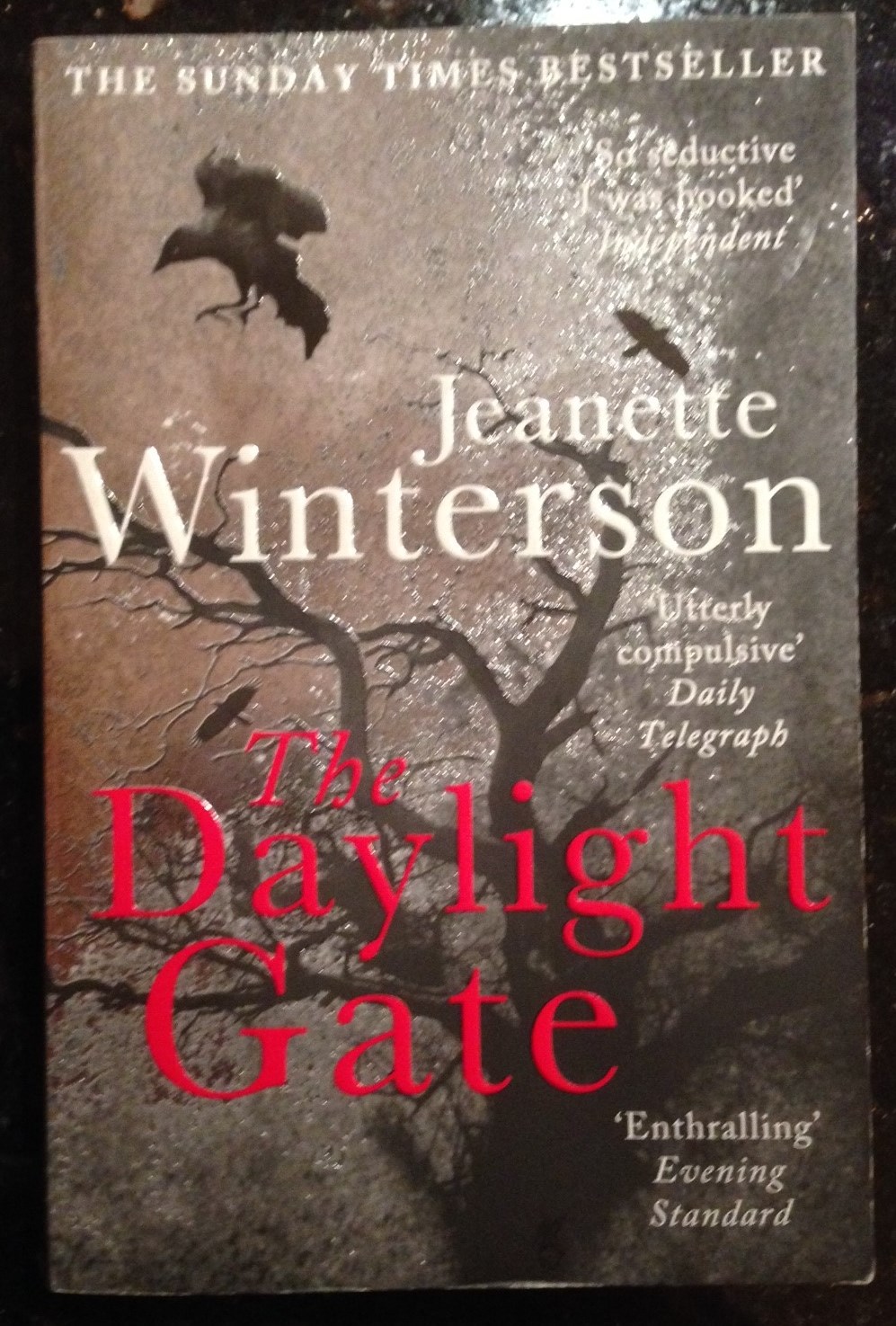
Kit’s Crit: The Daylight Gate (Jeanette Winterson)

Winterson

Starting from the assumption that Jacobean Lancashire was a rebel Catholic stronghold in a Protestant country, Jeanette Winterson’s version of the most famous English witch trials is quite unlike any other.  The Daylight Gate is a novella – not the hefty Victorian saga first told by Harrison Ainsworth – and it often strays away from the recorded historical facts.  Indeed, this book examines witchcraft and Catholicism as “matters treasonable and diabolical” in an impressionistic, modernist manner, which culminates in a broody tale where events appear blurred by the mists of time.

 Winterson takes a lot of poetic license with the facts as they are recorded in the trial documents, inventing new players, and placing famous people of that era in implausible situations.  Her Alice Nutter – the central character she admits is not true to the actual historical figure – is lured into witchcraft, knows William Shakespeare and the magician John Dee, appears younger than the matron who was actually executed, and is bisexual. Yet at the same time Justice Roger Nowell, who led the puritanical crusade against the local cunning folk, gets painted in an unexpectedly sympathetic light.

However, Winterson’s rough characters and brutal situations are credible for that time, area, and circumstance.  And she deftly strips away the romanticism found in some of the earlier novels based on these same events.  I particularly admire her intelligent justification for the motives and causes behind the three remaining puzzles: Why was a gentlewoman of Mistress Nutter’s rank convicted alongside the common poor?  Why did nine-year-old Jennet Device betray her entire family?  And why did some of the accused willingly confess to diabolical crimes?  Winterson has obviously considered these questions and reached her own conclusions about the excitement, hysteria, and sexual opportunities that open up during a witch hunt.  And while she does not dwell on the misogynist drive that fuelled men like Nowell, she does address the other power imbalances associated with gender, wealth, and rank.

I appreciate Winterson’s sparse, poetic technique that functions like a series of flashbacks to a dangerous, incomprehensible era that was ripe with suspicion and superstition – a place where poor women did what was necessary to survive.  Because they had no control over the real world they “must get what power they can in theirs,” though this is not a feel-good fairy tale where everyone lives happily ever after.

If you like intensity, and are open to magical realism, The Daylight Gate is an interesting introduction to the Pendle Witches.  But it is ultimately more of a literary horror story than a traditional historical fiction.

Copyright © 2022 | KitPerriman.com | All Rights Reserved

Kit’s Crit: Magic In Western Culture (Brian P. Copenhaver)

Copenhaver

Magic In Western Culture: From Antiquity to the Enlightenment (New York: Cambridge UP, 2015)

Brian Copenhaver’s Magic In Western Culture traces occult beliefs From Antiquity to the Enlightenment.  His study starts in Ancient Iran, Greece, and Rome, and moves through the early Christian Church to the influential thinkers of the Renaissance.  Magic is treated as a tradition that derives from classical philosophy, as Copenhaver examines why European intellectuals “repudiate magic in the Enlightenment, after having previously accepted it for more than two millennia” (xiii).

Copenhaver suggests that before the Enlightenment most educated Western people believed in magic – a tradition handed down from Herodotus.  But the early Catholic Church claimed any supernatural activity in The Bible was the result of divine miracles (not earthly magic), which created little problem until Thomas Aquinas insisted that if there were heavenly angels there must also be hell’s counterparts – demons.  Thereafter, devils were seen as tempting the faithful with magic powers and turning them into witches.   This belief persisted into the Middle Ages and beyond.

As further medical advances were made, traditional magic was superseded by new therapies – regimen, pharmacy, and surgery.  Doctors of Physic practiced a natural philosophy whereby physical treatment (not ritual or religious) aimed to produce the correct mix of humors in the body.

During the Renaissance, natural philosophy gradually gave way to mechanical science, particularly after the invention of the telescope and microscope.  Men like Descartes favored reason, method, and metaphysics over occultism, but this was not a clear-cut process.  Isaac Newton, for example, spent much of his scientific career as an alchemist searching for the Philosopher’s Stone, and was later called “the last of the magicians” (288).  But over the centuries, magic gradually succumbed to the dual pressures of religion and science until it fell out of fashion with the European intellectuals.

Magic In Western Culture is a dense, scholarly book, lightened in part by the rich illustrations.  Copenhaver has sifted through the murky realms of early belief to piece together a well-researched, cohesive analysis of the occult tradition.  His section on Newton is particularly fascinating.  I also enjoyed the references to Shakespeare’s plays that highlight the intersection between intellectual development and common folklore.

If you have an academic or historic interest in the rise and decline of magic you will find this book an impressive read.  Highly recommended!

Copyright © 2022 | KitPerriman.com | All Rights Reserved

Kit’s Crit: Lord of the Flies (William Golding)

Golding

Lord of the Flies

William Golding’s Lord of the Flies (1954) tops my list of all-time favorite books!

In the wake of a nuclear war, a group of school boys are being evacuated from England when their aircraft is shot down.  The survivors land on an isolated tropical island with no adult presence.  Here,they have to fend for themselves. The children ultimately form two rival gangs and soon cross the line from civilization into savagery.

There are three main reasons why Lord of the Flies is the perfect novel.  Firstly. it is an allegory that makes readers question their moral, spiritual, anthropological, and psychological beliefs about childhood innocence.  Secondly, Golding produces a beautiful cocktail of modern and poetic language where every sentence advances the action, or reveals something important about one of the central characters. And thirdly, he incorporates mythology, magical realism, anthropological research, religion, and psychology to build up the tension with carefully crafted foreshadowing and symbolism.  This is a very tight, taut, controlled horror story full of unpredictable events, where the only relief comes right at the end.

Lord of the Flies exposes the darkness of the human condition.  It is a pessimistic examination of everything we hold sacred.  And that is why it so wonderfully terrifying.

Copyright © 2022 | KitPerriman.com | All Rights Reserved