Witch Crime #4: Anne Boleyn was presented as a seductress by her early suitor, Sir Thomas Wyatt.
In Poem XI he writes –
Witch Crime #4: Anne Boleyn was presented as a seductress by her early suitor, Sir Thomas Wyatt.
In Poem XI he writes –
In today’s enlightened age, few would believe that Anne Boleyn was actually guilty of witchcraft. She may have had traces of an extra nail growing on her little finger, and possibly a mole on her neck, as reported by early biographer George Wyatt (grandson of Sir Thomas) who based his information from interviews with Anne’s former attendants. But who does not have any form of blemish on their body? Such flaws were obviously acceptable to King Henry when he desired her, but they appear to have been greatly magnified by her detractors in later years. By the time Nicholas Sanders gave his account a half-century later, the disgraced Queen was said to have buck teeth and a whole extra finger on her right hand! Yet the remains of a body thought to be Anne Boleyn’s, exhumed in the nineteenth century, showed no signs of skeletal abnormality. Of course, after three hundred years there would be scant trace of a mole or extra finger-nail remaining, but the evidence suggests that any imperfections Anne had were minor. So why were they interpreted as signs of devilry? A clue may be found in the English language.
The Malleus Maleficarum states that “The word ‘woman’ means ‘the lust of the flesh'”(43), which today can be understood as a psychological projection of blame onto the object of male desire. Women were seen as fickle, seductive creatures who would lead good Christian men astray. They made easy prey for demons to recruit, and then these familiar spirits would claim their victims with “witches marks” (moles, skin tags, supernumerary nipples, or birth marks) – places on the body where they could suckle human blood. Therefore every sexually-active woman was potentially the devil’s gateway.
Unfortunately, the dual concepts of wickedness and blame worked their way into everyday language. If a man found a woman attractive it was because she was consciously bewitching, beguiling, enchanting, charming, captivating, or seductive. Now as part of every day speech, such terms were harmless. But when certain courtiers wrote them into love songs and sonnets, then they became exceedingly dangerous. Especially for a suspect Queen.
It seems unlikely that Sir Thomas Wyatt (1503-1542) and Anne Boleyn ever consummated their close relationship, despite the fact he was an ardent suitor of Mistress Boleyn before King Henry started noticing her. With the reputation for being one of the best poets of his age, Wyatt used clever wordplay and an ambiguous “I” speaker in the poems thought to have been written with her in mind: “Whoso list to hunt, I know where is an hind,” “What word is that that changeth not,” “If waker care, if sudden pale colour,” and “Sometime I fled the fire that me brent.” The poet was arrested in May 1536, charged with committing adultery with the Queen. Five other men were also accused, but he was the only one who escaped execution – proof enough that Henry believed his relationship with Anne was platonic.
And yet the beautiful words in Wyatt’s love sonnets may have ultimately helped to condemn his lady. Find out how in Part Four.
Sources for Part Three:
Daalder, Joost. Sir Thomas Wyatt: Collected Poems (Worldwide: Oxford UP, 1975)
Foley, Stephen Mirriam. Sir Thomas Wyatt (Boston: Twayne, 1990)
Kramer, Heinrich, and James Sprenger. The Malleus Maleficarum (New York: Dover, 1971)
Wiatt, William H. “Sir Thomas Wyatt and Anne Boleyn” in English Language Notes, Vol. VI (December, 1968). Colorado: U of Colorado, 1968. 94-102.
(Picture: Public Domain)
Copyright © 2022 | KitPerriman.com | All Rights Reserved
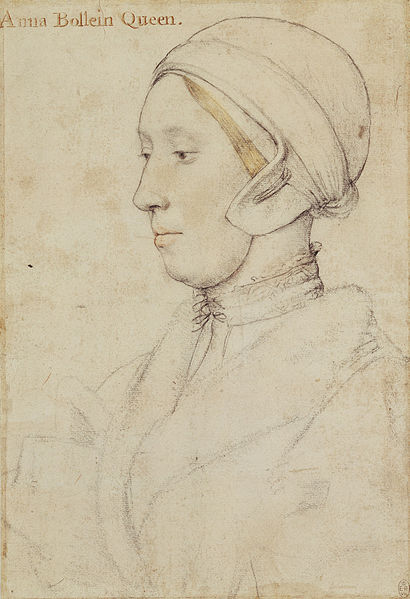
The Malleus Maleficarum stated that, aside from fornication, “the chief aim of the devil is to corrupt faith” (43), which the English Catholics interpreted as the influx of Lutheranism coming from Henry’s break with Rome, after his marriage to Mistress Boleyn. Bluff King Hal was beyond reproach, but his concubine was not. Anne – an intelligent, radical thinker with her own ideas about religion – became a rallying point for the Reformers. But how much of a Protestant was she? Katherine Lindsay’s book Divorced, Beheaded, Survived points out there was no record of the queen “denying the doctrine of transubstantiation, one of the central Protestant concerns,” and she clung to the Catholic notion that “good works could assure a place in Heaven,” as opposed to the Lutheran “insistence on justification by faith” (100). It seems evident, therefore, that the queen believed herself to be a good Christian. But the plotting courtiers painted her in an entirely different light.
Witch Crime #2: Anne Boleyn was suspected of being a key player in a diabolical plot to overthrow the Church of Rome.
Archbishop Chapuys reported to his employer (Emperor Charles V) that His English Majesty was “bewitched by this cursed woman . . . does all she says, and dare not contradict her” (Chapman, 151). For as Alison Weir explains in The Six Wives of Henry VIII, Cromwell had told him the king “made this marriage seduced by her witchcraft, and for that reason he considered it null and void” (304). The Malleus decreed that “if witchcraft takes effect in the event of a marriage” it “destroys the contract” (4). This gave the unhappy husband a loophole to be rid of Anne so he could wed Jane Seymour instead. By itself, however, enchantment was not a sufficient reason to execute a royal wife. Other charges were needed. So as the case against Anne grew she became accused of “having poisoned the late Queen Katherine [and] attempting to do the same to Lady Mary” (Weir, 326) – which on top of the multiple counts of adultery, including incest with her brother, amounted to the heinous crime of witchcraft.
Exodus 22:18 commands, “Thou shalt not suffer a witch to live,” and the Catholic Inquisitors were quick to condemn all women as inherently wicked “because of the first temptress, Eve, and her imitators” (Malleus, 44). According to Pierre Brunel’s Companion to Literary Myths, Heroes, and Archetypes the sorceress became “the core, the center of all that cannot be understood or accepted.” She attracted fear, hatred, and loathing until she was no longer seen as a human being but instead turned into “the expression and cause of the misfortune” suffered by all (1165). In short, the cunning woman became the royal scapegoat.
Witch Crime #3: Being an instrument of darkness, Anne Boleyn was directly and indirectly responsible for all the wrongs in the kingdom.
Yet who did the most damage to the Queen’s reputation? The answer may surprise you! Check back for Part Three tomorrow..
Sources Cited in Part Two:
Brunel, Pierre. Companion to Literary Myths, Heroes, and Archetypes (London and New York: Routledge, 1992)
Chapman, Hester W. Anne Boleyn. (London: Cape, 1974)
Holy Bible (London: Collins)
Kramer, Heinrich, and James Sprenger. The Malleus Maleficarum (New York: Dover, 1971)
Lindsey, Karen. Divorced, Beheaded, Survived (Worldwide: Addison-Wesley, 1996)
Weir, Alison. The Six Wives of Henry VIII (New York: Ballantine, 1993)
(Picture: Public Domain)
Copyright © 2022 | KitPerriman.com | All Rights Reserved
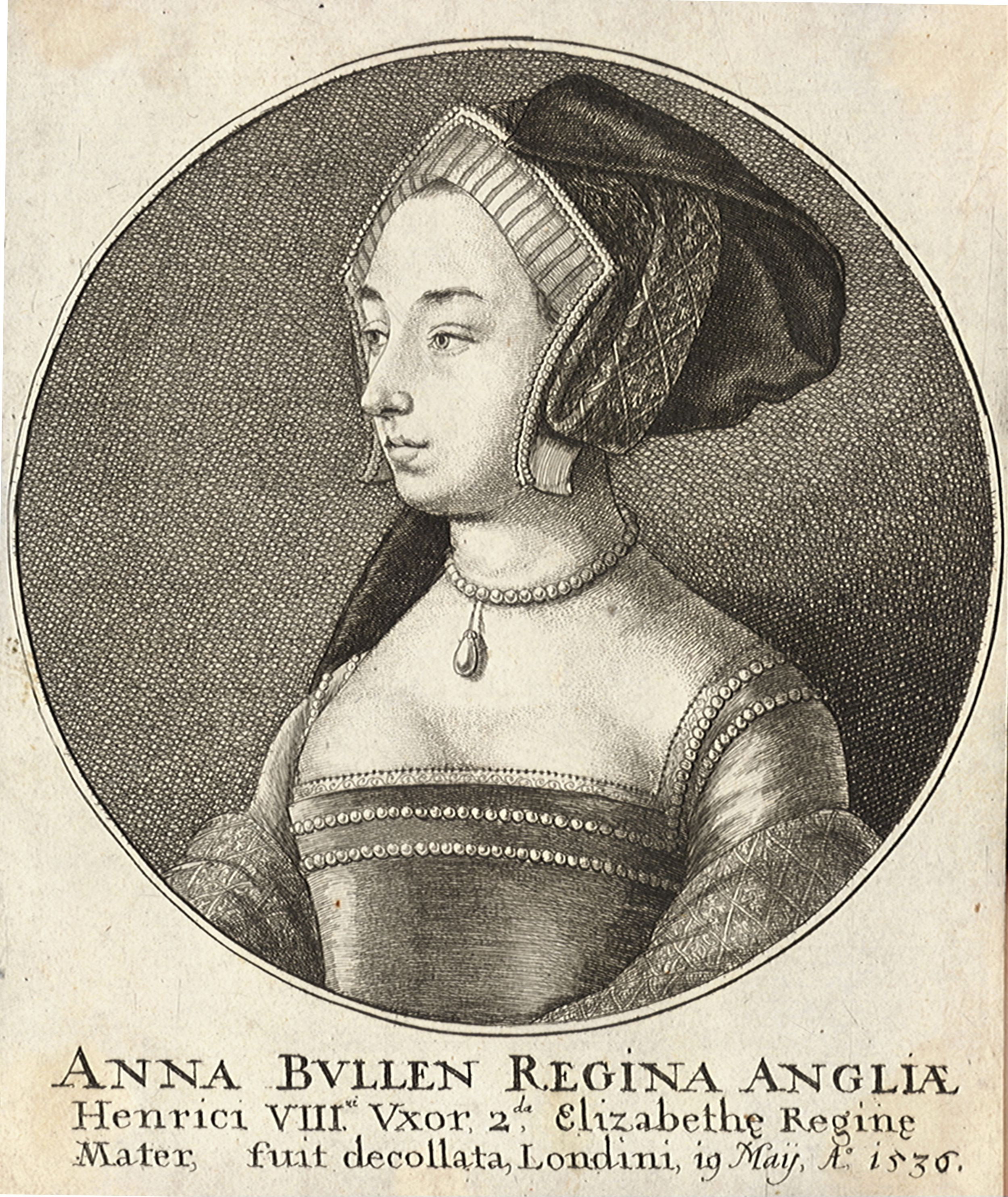
How could anyone believe that the crowned Queen of England was a witch? Of all the accusations made against Anne Boleyn (c. 1501-1536) this seems the strangest to the modern observer. But the Tudors were more than willing to accept the king’s second wife was guilty of a whole list of diabolical crimes. Let us examine why.
Although witches had been persecuted for over a hundred years on the European Continent, the first statute was not passed in England until 1542, when the Catholic clergy persuaded their congregations that Satan’s army was on the march. This was likely the direct result of the widespread distribution of the Malleus Maleficarum (1486) – the prominent and damaging witch-finder manual written by two German Inquisitors, Heinrich Kramer and James Sprenger. The Malleus was intended to halt pagan practices, but instead it triggered a wave of witch hunts that resulted in countless innocent deaths.
James Sharpe, in Instruments of Darkness, explains how the Reformation caused similar concerns among the early Protestants because “Idolatry included not only witchcraft but also the telling of the rosary, going to Mass, and saint worship” (27). But while Catholicism and sorcery were the twin evils in the early Lutheran mind, the Papists thought Protestants and witches were heretics too. And as Hester Chapman’s biography claims, it was not a huge leap for the Catholics to see Protestant Anne Boleyn as the temptress whose “advent had brought about disaster on the kingdom. She was the personification not only of evil, but of an assault on religion, crops, cattle, fair weather – every aspect of daily life” (106).
Unfortunately, Mistress Boleyn was an easy target. An unconventional beauty, her enemies claimed she bore the mark of the devil from birth in an extra finger (or finger nail), and that she had numerous moles, which were widely associated with wicked women. But as Antonia Fraser reveals in The Wives of Henry VIII, as a mature lady she “exercised a kind of sexual fascination over most men who met her” (123). Anne was condemned for adultery with several others, but because the cuckolding of a king had no legal precedent, this alone was not a Capital offence. Thomas Cromwell therefore had to imply hundreds of liaisons between Boleyn and her lovers because the Malleus claimed “all witchcraft comes from carnal lust which is in women insatiable”(47). If she could be proven to be a lascivious witch – especially one who intended to use magic to harm or kill members of the Royal Family – then she could be sentenced to death. Not for witchcraft per se (because laws against this specific problem had yet to be passed in Henry’s reign) but rather for the ambiguous, treasonable act of betraying the sanctity of marriage and entertaining malice against the king.
Witch Crime #1: Anne Boleyn was a wicked seductress who intended to harm the royal Defender of the Faith and destroy his Christian kingdom.
Part Two tomorrow . . .
Sources Cited in Part One:
Chapman, Hester W. Anne Boleyn (London: Cape, 1974)
Fraser, Antonia. The Wives of Henry VIII (New York: Random, 1994)
Kramer, Heinrich, and James Sprenger. The Malleus Malficarum (New York: Dover, 1971)
Sharpe, James. Instruments of Darkness: Witchcraft in England, 1550-1750 (London: Hamish Hamilton, 1996)
(Picture: Public Domain)
Copyright © 2022 | KitPerriman.com | All Rights Reserved
Put To Question: The Stappado
Torture was banned under English Law except in certain circumstances,
but some unfortunates fell prey to The Strappado:
“They tied my hands behind my back. Then they hung me from a door. It feels like they are stretching you from all sides. My torso was twisted and my shoulders were dislocated from their joints from time to time. The pain cannot be described. The [Inquisitor] was shouting, ‘Confess or you will die here’.”
(Confession: Public Domain Records)
(Drawing: Public Domain)
Copyright © 2022 | KitPerriman.com | All Rights Reserved
Put To Question: Pressing
Torture was not allowed under English law unless by royal decree –
but some folk still got pressed to death by the peine forte et dure!
“he will lie upon his back, with his head covered and his feet, and one arm will be drawn to one quarter of the house with a cord, and the other arm to another quarter, and in the same manner it will be done with his legs; and let there be laid upon his body iron and stone, as much as he can bear, or more.”
(Confession: Public Domain Records)
(Drawing: Public Domain)
Copyright © 2022 | KitPerriman.com | All Rights Reserved
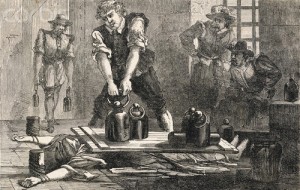
Put To Question: The Thumbscrews
Torture was not allowed under English law without permission from the king
but the thumbscrews or pilniewinks crushed even the strongest will.
“. . . in 1596, the son and daughter of Aleson Balfour, who was accused of witchcraft, were tortured to make her confess her crime in the manner following: Her son was put in the buits where he suffered fifty-seven strokes; and her daughter about seven years old, was put in the pilniewinks . . .”
(Confession and Photo: Public Domain Records)
Copyright © 2022 | KitPerriman.com | All Rights Reserved
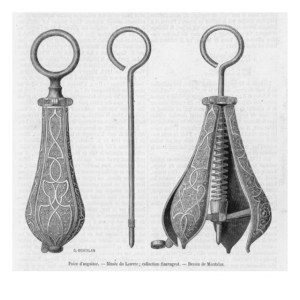
Put To Question: The Pear of Anguish
Torture was not allowed under English law . . .
but those Wise Women who helped young lassies to miscarry their shame were sometimes punished with The Pear of
Anguish:
It was pushed up between the legs and unscrewed into four brutal petals that tore the insides apart.
(Image Source http://www.medievalarchives.com)
Copyright © 2022 | KitPerriman.com | All Rights Reserved
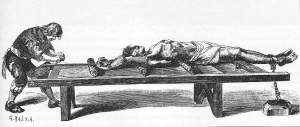
Put To Question: The Rack
Torture was technically not allowed under English law unless royal consent had been given in advance.
Traitors and heretics often got stretched on The Rack:
“We went to the torture room in a kind of procession, the attendants walking ahead with lighted candles.
The chamber was underground and dark, particularly near the entrance. It was a vast place and every device and instrument of human torture was there. They pointed out some of them to me and said I would try them all. Then he asked me again whether I would confess.
‘I cannot,’ I said.”
(Father John Gerard, 1597)
(Picture: Public Domain)
Copyright © 2022 | KitPerriman.com | All Rights Reserved
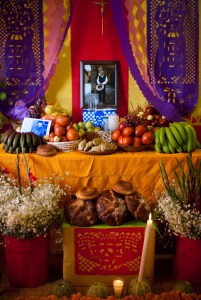
Dia de los Muertos
(Photo: Eneas de Troya)
Sources:
National Geographic Society, “Dia de los Muertos,” https://www.nationalgeographic.org/media/dia-de-los-muertos/
History.com Editors, Day of the Dead (Dia de los Muertos) https://www.history.com/topics/halloween/day-of-the-dead
Visit to Mexico, 2011
Copyright © 2022 | KitPerriman.com | All Rights Reserved