Magic Colors

rainbow-ribbon-flames[1]

(Photo: Public Domain)

Colors have always affected the human psyche.  They create atmosphere, change moods, signal danger, hide flaws, disguise predators, indicate states of mind, and relieve stress.  And because they trigger such potent reactions in people, many cultures have used them to influence, honor, or impress their gods.

Medieval cunning folk were no exception.  They used sacred clothing, color-coded surroundings, or dyed candles for their rituals.  But the meaning of certain colors can vary – for example, a black candle might be lit in a shape-shifting spell, while its partner stone (onyx) could be used for protection.  Sorcery and alchemy were complicated arts.

Even today, the meanings associated with color are open to personal interpretation, for what is pleasing and soothing to one eye might be unpleasant and jarring to another.  Yet within modern Wicca there appears to be a loose agreement on the following associations.  Choose whichever works for you!

WHITE: purity, protection, peace, happiness, spirituality, balance

GREEN: health, money, luck, acceptance, growth, fertility, beauty, employment

ORANGE: attraction, success, creativity, fun, opportunity, celebration

YELLOW: pleasure, intellect, confidence, inspiration, wisdom, psychic power, divination

RED: strength, passion, survival, courage, good fortune, health, power, sexual potency

PINK: love, self-improvement, friendship, fidelity, compassion, nurturing, maturity

GRAY: peace, neutrality, contemplation, solitude

BROWN: health, home, healing, blessings, stability

BLUE: forgiveness, psychic awareness, healing, sincerity, peace, sleep, focus, organization

BLACK: banishing, the void, protection, shapeshifting

PURPLE: wisdom, healing, power, luck, scrying, reversing

SILVER: female energy, victory, stability, intuition

GOLD: masculine energy,  attraction, justice, health, luxury


Sources:

“Llewellyn’s Witches’ Calendar” (Korea: Llewellyn, 2015)

“Understanding the Meaning of Colors in Color Psychology.” available at http://www.empower-yourself-with-color-psychology.com/meaning-of-colors.html (2/26/2015)

Copyright © 2022 | KitPerriman.com | All Rights Reserved

Brighid: Goddess and Saint

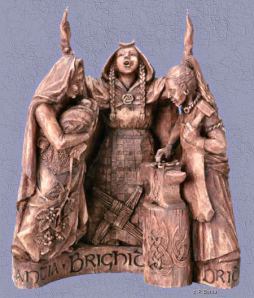
The Wise Women of Britain had their own special patron – the goddess Brighid – who later became known as Saint Brigit.  She was a Celtic pagan deity, the equivalent of Roman Minerva and Greek Athene, whose name meant exalted one.  In Irish mythology, Brighid was the daughter of Dagda, wife of Bres, and the mother of Ruadan – the son she invented keening for when he died in battle.

Brighid

Brighid was one of three sisters (all named Brighid) who jointly made up the Triple Deity – maiden, mother, crone.  For many years she was closely associated with Wise Women and became the goddess of healers and magicians.  Called on for assistance with prophecy and divination, Brighid represented wisdom, intelligence, excellence, perfection, craftsmanship, artistry, healing, and druidic knowledge.  Because she protected pregnant women and aided in childbirth, she was also connected with the hearth and home.

At some point in the Middle Ages the Catholic Church syncretized Brighid into the Christian St. Brigit of Kildare, making her the keeper of the eternal flame (from her former role of protecting Druid priestesses) and tender of holy healing wells (as she was already widely associated with medicine).  Her festival day at the start of February marks the arrival of spring, but instead of being called Imbolc it then became known as St. Brigit’s Day instead.

Brighid is the patron saint of poetry, blacksmithing, arts and crafts, cattle, and serpents.  She is credited with inventing the whistle.  Her symbols include the hearth, cauldron, forge, and bridal bed.  Corn dolls, crosses, and knots have been named after her, and she is connected with cats, foxes, cows, bees, and wrens.

Corn Doll

The last time I visited St. Mary’s Church at Newchurch-in-Pendle I was delighted by the collection of rush decorations nailed along the walls, carefully fashioned into crosses, knots, and dollies.

The old traditions die hard!

(Photos: Public Domain)


Sources:

Lockhart, Elaine. “Brighid: A Personal Relationship” in Modern Witch,  First Issue, Imbolc, 2012 (p8-9)

About Religion. “Brighid: Hearth Goddess of Ireland.” Available at http://paganwiccan.about.com/od/godsandgoddesses/p/Brighid_Profile.htm (2/25/2015)

Wikipedia:  “Brigid”

Copyright © 2022 | KitPerriman.com | All Rights Reserved
In The Beginning . . .

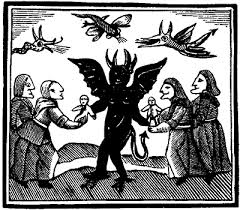
Throughout the Middle Ages,Lancashire was ripe with tales of cunning folk.  In 1595 a conjure man called John Hartley convinced the Starkies of Huntroyde that seven members of their household were possessed by demons.  The Starkies were related to Roger Nowell, a Justice of the Peace from nearby Read who spearheaded the infamous Lancashire Witch Hunts of 1612.

Devil

King James 1st became ruler of England in 1603 – the same year Jennet Device was born into the Demdike Clan at Malkin Tower – and the same year that a terrible plague swept the land.  Two years later Guy Fawkes’ Jesuit Gunpowder Plot failed to blow up Parliament, but it did trigger a nation-wide persecution of priests at a time when Lancashire was still a Catholic stronghold.

Witches, ghosts, and boggarts were a part of English folklore, inspiring many weird and wonderful tales that included Shakespeare’s Macbeth (1606).  The wise women of Pendle Hill worked the superstitious locals to eke out a meager living.  They offered a wide range of services from basic herbal medicine to midwifery and abortion – concocting charms, curses, love spells, and potions – claiming they could heal, harm, and foretell the future.

On March 21st in 1612, Old Demdike’s teenage granddaughter – Alizon Device – set off to go begging in Colne.  On the way she met a peddler called John Law who refused to give her the pins she demanded and so she cursed him.  Moments later Law collapsed, paralyzed down one side of his body.  He pointed the finger at Alizon Device and his son went straight to the authorities.  Because Alizon was one of the notorious Demdikes the rest of her family were rounded up for examination and before long, the Lancashire Witch Hunts had begun.

(Drawing: Public Domain)

Copyright © 2022 | KitPerriman.com | All Rights Reserved