Olde English Honey Crispels

Try this medieval recipe for a sweet, fried pastry called Honey Crispels.

Ingredients

8oz plain flour

4oz butter (to rub in)

1-2oz butter (as needed for frying)

pinch of salt

I egg

2-3 tablespoons cold water

8 tablespoons honey

sprinkle of nutmeg or cinnamon

Method

1. Place the flour and salt in a bowl.  Cut up the butter and rub in the flour until the mixture looks like large breadcrumbs.

2. Add the egg and sufficient water to bind in a dough.

3. Roll out on a floured surface to a thin pastry dough. Cut in 2-3″ circles.  (Hint: To hold more honey, fashion a small lip round the edge of each circle so there is a slight hollow in the center).

4. Heat the butter (without burning) in a large frying pan.  Fry each round of dough until crisp.  Set on the paper to drain.

5. Slowly bring the honey to a boil over a medium heat, skimming any scum from the surface.  Stir well to clarify.  Brush over the surface of each fried pastry allowing some of the mix to sit and cool in the trough.

6. Modern Version: Dust with icing sugar, nutmeg or cinnamon.

7. Enjoy warm or cold.

* This recipe makes 4-8 crispels, and they take 2-5 minutes to fry, depending on size.  Larger crispels are light and flaky.  Smaller ones tend to be crunchier.

Honey Crispels

(Photo: Public Domain)

Copyright © 2022 | KitPerriman.com | All Rights Reserved

The Scrying Game

Since the days of the Ancient Persians, wizards, witches, and Romany gypsies and have sought for ways to look beyond the familiar world around them.  Cunning folk have stared into fire, water, polished stone, magic mirrors, and crystal balls, seeking divination of hidden knowledge – visions of future events – or clairvoyant arts to find lost objects and detect criminals.

Scrying is a common Celtic practice too.  It comes from the Old English word descry and means to make out dimly or to reveal the past, present, or future.  Used to detect chaos, evil, good, and magic, scrying often brings a message.  The seer goes into a trance and uncovers a series of hidden images, rather like a movie playing inside their skull.  But the visions are symbolic and need interpreting, which is a skill that is only learned and honed over time.

Look into Kit’s crystal ball below.  I see you – if you see me too then perhaps you’ve also got the gift!

Crystal ball

(Photo: Public Domain)

Copyright © 2022 | KitPerriman.com | All Rights Reserved

A Less-Known Lancashire Witch: Meg Shelton

Aside from the infamous Pendle Witches who were put on trial in 1612 and 1634, there were other unfortunate victims maligned and persecuted throughout Lancashire.  Many of their names were never recorded.  Some were accused and later released – some went to court and were found Not Guilty – and some were undoubtedly dealt with by the locals in their own ways.

In these unenlightened times it was common for women denounced as witches, shrews, and gossips to be locked inside a scold’s bridle – a metal brank that caged the head and prevented eating or speech.
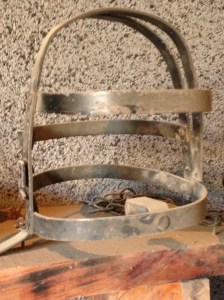
scold

(Photo: Kit Perriman)

Public floggings and placement in the stocks were also regular market-day events.  And tales of dunking suspected witches in near-by ponds and rivers to see if they were guilty (and floated) or innocent (and drowned) are part of local folklore.  So it is quite surprising that one other name still fills the local schoolchildren with terror – Meg Shelton, The Fylde Hag.

Born Margery Hilton, Meg (or Mag) Shelton is said to have lived at various times in Cuckoo Hall near Wesham, Singleton, Catforth, and Woodplumpton.  She was a poor beggar woman who survived mainly on a haggis made from boiled grouts and herbs.  Meg is infamous for her shape-shifting skills, and apparently could turn into a variety of animals and all sorts of inanimate objects at will.  One tale records her creeping into a barnyard at night to steal corn.  When the farmer ran out after her there was no one in sight, though he did notice an extra sack of corn.  So taking his pitchfork he prodded each bag, finally uncovering Meg’s disguise when she squealed and reappeared nursing a bleeding arm!  Another of her injuries was explained by an accident trying to outrun a black dog when she was disguised as a hare.  The dog nipped the hare’s hind leg – and Meg was said to walk with a limp thereafter.  Meg was often seen riding her broomstick at night.  She could turn milk sour, lame cattle, and  curse hogs.

But the reason folk remember the Fylde Hag today is because of the strange events surrounding her death.  She was killed in 1705, crushed between a barrel and the wall of her cottage.  She was buried on May 2nd, at night, by torchlight, in the grounds of St. Anne’s Church in Woodplumpton.  The following morning her hand had clawed its way to the surface and had to be reburied.  The same thing happened again and everyone was naturally terrified.  A priest came and performed an exorcism.  Then someone suggested they rebury her upside down so she would dig her way to Hell, instead of to the surface.  So they planted her head-first in a narrow trough, and then put a huge granite boulder on top to keep her in place.

In hindsight it seems odd that a known witch would be put to rest on consecrated ground.  Usually they were buried at a crossroad with no signposts so they could not find their way home.  Or their bodies were burned.  And it is entirely possible that the granite stone in  St. Anne’s graveyard is a harmless relic carried down by the ice age.  But superstition is often stronger than common sense – and we all like to believe in a little magic.

Over the centuries, the legend of Meg Shelton has survived and flourished.  I grew up being told that if you walked three times round her grave chanting, I don’t believe in witches, then that hand would rise up from the grave and grab your ankle.  But I cannot say if that actually happens or not as I never dared try!

Shelton Grave

Meg Shelton’s Grave (Photo: Brian Young)

Source:

Ashworth, Elizabeth. Tales of Old Lancashire (Berkshire: Countryside,2007)

Copyright © 2022 | KitPerriman.com | All Rights Reserved

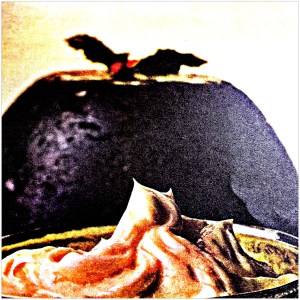
Olde English Christmas Pudding

Christmas Pudding2

Ingredients:

4oz plain flour

2oz breadcrumbs

4oz shredded suet

4oz brown sugar

4oz grated apple

1 grated carrot

4oz mixed fruit peel (candied peel)

3 eggs

4oz currants

8oz raisins

4oz sultanas

2oz chopped dried apricots

4oz blanched chopped almonds

1 lemon – grated rind and juice

1 tablespoon treacle

1/4 pint beer or milk

2 tablespoons brandy

1 teaspoon mixed spice

I teaspoon cinnamon

1 teaspoon grated nutmeg

pinch of salt

nub of butter for greasing pudding bowl

Method:

1. Mix all the ingredients together in a large bowl.  Stir thoroughly.  Cover and leave overnight in the refrigerator.

2. Grease a large pudding bowl.  Add the mixture and press down well.  Cover with pleated greaseproof paper (allowing the pudding to rise and expand) held in place with an elastic band.

3. Place in a steamer and boil for  6-8 hours until the center is cooked through.  Remove wet paper.

4. When the pudding is completely cold wrap in cling-film and store in an airtight container.

To Serve On Christmas Day:

1/4 cup brandy for firing

1 pint whipped thick fresh cream

5. Turn out pudding on to a microwave-safe plate.  Heat (full power) in a microwave for 3-4 minutes until steaming.  Place on dining table.

6. Pour over brandy.  Carefully set the alcohol alight with a long match to flavor the pudding.

7. When the brandy burns out the pudding is ready to slice.

8. Serve with fresh whipped cream.

(Photo: Public Domain)

Copyright © 2022 | KitPerriman.com | All Rights Reserved

Kit’s Crit: The Wise Woman (Philippa Gregory)

Gregory

The Wise Woman by Philippa Gregory

This historical fiction begins in 1540 and follows the tragic life of seventeen-year-old Alys, a young peasant girl in Tudor England.  Alys grew up on the moor with a harsh foster-mother called Morach, the local wise woman.  But turning her back on superstition and the pagan arts, Alys decides to join a nunnery.  For a time she finds contentment in this orderly sanctuary.  She enjoys the rigid structure, comparative luxury, and the safety afforded to the Holy Sisters.

But Alys happiness is short lived.  One night the monastery burns to the ground, a casualty of King Henry’s Reformation, and the young woman is summoned to the local castle to work as a scribe for the ailing lord of the manor.   Here she falls in love with his married son and heir, Lord Hugo.  She grows intently jealous of the Lady Catherine, and seeks to replace her in Hugo’s bed.  Calling on all the cunning tricks she recalls from living with Morach, Alys devises a difficult, disturbing plot to gain her heart’s desire.  At this point the novel slips into magical realism.

Gregory’s story has many Faustian overtones.  Alys conjures up the powers of darkness to possess the man she fixates on, aware that her actions are prompted by self-promotion rather than genuine love.  By the end of the book the Wise Woman is exposed as self-centered, unlikable, and evil – and therefore she meets with a hellish end.

The Wise Woman can also be read as a morality tale.  Although Alys is a victim of historical circumstance, feudalism, and gender, she serves as a warning against forbidden love and obsession.  She tries to take the rightful place of another woman – a place where she can never truly belong.  Alys discovers she has the power to unleash terrible things on the world, but by the time she realizes she has little control over them, it is too late to go back.  She sinks further and further into witchcraft.

I enjoyed the atmospheric setting of Gregory’s novel, and not expecting to sympathize with the central characters I was pleased to find them portrayed in a refreshingly honest way – warts and all!  The historical research is sound and convincing, and any book set in the medieval era must acknowledge the common superstitious beliefs of that time.

This is not a feel-good story.  It suggests everything in Alys’ world is a sham – magic, life, love, faith, and family.  But one of the great joys of reading is the ability to close the book at any point and find yourself back in the twenty-first century!

Copyright © 2022 | KitPerriman.com | All Rights Reserved

Shape-shifting

A shape-shifting spell from the Scottish wise woman, Isobel Gowdie:

I shall go into a hare,

With sorrow, and sigh, and much care;

And I shall go in the Devil’s name,

Aye while I come home again.

I shall go into a cat,

With sorrow, and sigh, and sudden pain!

And I shall go in the Devil’s name,

Aye while I come home again

I shall go into a crow,

With sorrow, and sigh, and convulsion!

And I shall go in the Devil’s name,

Aye while I come home again.

Shape-shifter

Adapted from Joyce Froome’s book, Wicked Enchantments (Lancaster: Carnegie, 2010)

(Picture: Public Domain)

Copyright © 2022 | KitPerriman.com | All Rights Reserved