Vivien: The Lady of the Lake

Vivien and Merlin

“For Merlin, overtalked and overworn,

Had yielded, told her all the charm, and slept”

(Alfred Lord Tennyson)

Most Arthurian legends feature Merlin’s love-interest, Vivien.  She usually appears as The Lady of the Lake and ruler of Avalon, but sometimes she is described by other names such as Nimue – Niviane – the daughter of a vavasor named Dionas – a princess of Northumberland – or the Queen of Sicily.  And like the great magician himself, her character has undergone several important changes throughout history.

In the majority of early versions Vivien meets Merlin by a spring in the Forest of Broceliande, Brittany.  They fall in love, share a relationship, and exchange supernatural knowledge.  The Lady of the Lake is associated with water, the essential essence of life, and she quenches the lonely old man’s thirst for companionship.  She also gives King Arthur the magic sword Excalibur, and raises Lancelot in Avalon after the death of his father.  Then she takes Merlin away from Camelot and he is never seen again.

In Thirteenth Century Pre-Vulgate French mythology, Vivien is a fairy.  She appears as Merlin’s adoring student and he falls in love with her youth, intelligence, and beauty.  When Vivien uses one of her mentor’s spells to create a magical tower that locks them both away from the rest of the world, she does so to preserve their happiness together.  She acts out of genuine love without any deception or malice.

But when the Catholic Church adopted King Arthur as a champion of Christianity, Vivien was transformed into an evil sorceress and witch.  She is thereafter portrayed as another Eve-like temptress who seduces a good man and brings about his downfall.  In these tales she uses her feminine wiles to uncover Merlin’s most powerful spell and ultimately uses it against him.  Then she locks him in an enchanted tree – or prison made of air –  or tomb covered with a stone that no one can move – rendering him invisible from the outside world until he falls asleep forever.

In the post-feminist era, however, this fascinating character has evolved yet again and  Vivien emerges as the New Woman.  No longer is she portrayed as a dependent fairy or malicious witch.  Instead she has become a strong force in society – a free thinker –  someone in charge of her own destiny.  She lives with Merlin as a lover and equal.   She could survive perfectly well without him, but chooses not to.

The modern Lady of the Lake tale now suggests that mutual love is the greatest magic of all!

Sources:

Brunel, Pierre.  Companion to Literary Myths, Heroes and Archetypes. London and New York: Routledge, 1996.

Collier’s Encyclopedia (15).  Macmillan, 1974.

Wikipedia, “Lady of the Lake”  http://en.wikipedia.org/wiki/Lady_of_the_Lake

(Picture: Julia Margaret Cameron)

Copyright © 2022 | KitPerriman.com | All Rights Reserved

Merlin: Madman or Magician?

merlin

There are many contradictory legends surrounding the famous magician, Merlin.  Tolstoy suggests he was a real Druid who lived in Sixth Century Scotland, though it is more likely that the sorcerer was actually a composite created from several mysterious literary figures.

Most stories agree that Merlin was the son of a nun who was impregnated by an incubus in her sleep.  This means he was born of a devil and a virgin.  The demon gave him knowledge of the past – but the nun had the child baptized at birth to protect him from Satan – and in order to create a natural balance in the universe God granted the child a prophetic knowledge of the future.  His life was thereafter spent on the threshold of good and evil.

The Welsh claim Merlin as one of their own Celtic prophets and magicians.   In British mythology he was the protector of the young King Arthur.  Merlin was often portrayed as a princely figure who was overcome by madness.  He ran off to live in the forest and there acquired the supernatural powers that made him famous.

Some tales claim that a disguised Merlin slept with the Duchess Igerna and fathered the future King Arthur.  In other versions Merlin helped King Uther Pendragon to seduce Igerna, whom he married a short time later.  Either way, Arthur was protected by the wizard until the time was right for him to step forward and be crowned the king.

Merlin made the Round Table for King Uther.  It is also said that he created Stonehenge, in memory of Uther’s brother who was massacred at the Battle of Salisbury.  The wizard was said to control the wind, foresee the future, and transform his shape at will.  He once made a dragon on a banner breathe real fire, and enchanted a bed so that those who slept on it lost all sense and memory.

The magician’s most famous saying is, Who aims to cheat a friend / Gets cheated in the end.  Yet his wisdom did not stop him falling into the clutches of Vivien – the Lady of the Lake who brought about his end!

Sources:

Brunel, Pierre.  Companion to Literary Myths, Heroes and Archetypes. London and New York: Routledge, 1996.

Collier’s Encyclopedia (15).  Macmillan, 1974.

Wikipedia, “Merlin.” http://en.wikipedia.org/wiki/Merlin.

(Drawing: Public Domain)

Copyright © 2022 | KitPerriman.com | All Rights Reserved
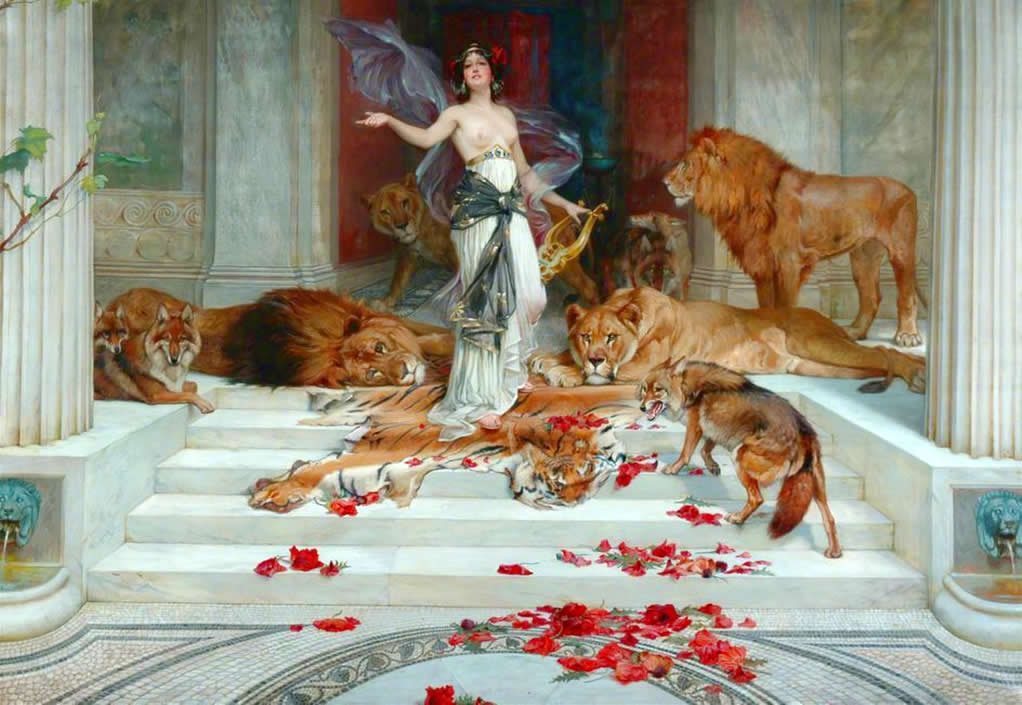
Circe the Witch-Goddess

Circe

Circe – one of the foremost witch goddesses from the European literary tradition – was immortalized in Homer’s Odyssey.  Offspring of the sun-god Helios and a sea nymph called Perse, Circe lived on the island of Aeaea.  Some sources, however, claimed she was the daughter of the dark goddess Hecate because of her association with the moon.

The fair-haired Circe was skilled in the arts of transformation and illusion.  She was also the mistress of glamor magic with a vast knowledge of potions and herbs.  In Homer’s tale she transformed Odysseus’ men into pigs with human intelligence.  Eurylochus escaped the enchantment and managed to warn Odysseus, who had remained behind to guard their boat.  On the way back to rescue his crew the hero was met by Hermes and given a magic plant called moly to protect him from the witch.  Odysseus overpowered Circe, demanded that his men be restored to their human forms, but then he stayed on the island with her for another year.  During this time he fathered a son called Telegonus, the boy who eventually killed him with a poisoned spear.  Later, Circe was slain by Telemachus – Odysseus’ legitimate son with Penelope.

Botanists suggest that enchanter’s nightshade could have been one of Circe’s magic plants because it contains an anticholinergic that produces hallucinations, and may make men believe they have been transformed into animals.  Also, moly might derive from the snowdrop, as this flower contains the anti-hallucinogenic compound called galantamine.  

Circe appears to have functioned as a symbol of luxury and wantonness, perhaps as a warning against the drunkenness, lust, and debauchery that made men act like pigs. But unlike other mythological hags who rendered men impotent, she was a beautiful, alluring witch figure who catered to their sexual fantasies instead.  Small wonder her fame lives on!

Sources:

Graves, Robert. New Larousse Encyclopedia of Mythology.  Worldwide: Hamlyn, 1977.

Oxford Classical Dictionary (Third Edition).  Oxford: Oxford University Press, 1996.

Wikipedia: “Circe”  http://en.wikipedia.org/wiki/Circe

(Painting: Wright Barker)

Copyright © 2022 | KitPerriman.com | All Rights Reserved

A Biblical Puzzle: The Witch of Endor

Endor  (Painting: Benjamin West)

The Witch of Endor (1 Samuel: 28) is one of the great puzzles of the Old Testament.  She was the medium who summoned the dead prophet Samuel’s spirit at the request of King Saul, and then comforted the king when he received the terrible news of his impending defeat and death.  Yet the one true Wise Women in the scriptures was not originally portrayed as being evil, manipulative, or sinister.

Ironically, Saul had previously driven all the magicians and cunning folk out of Israel.  But when God stopped appearing in his dreams – and the Philistine army was at his door – the desperate king went in search of a medium to help him contact Samuel’s ghost for advice.  During the 11th Century this witch (named Abner) was thought to have been the mother of Saul’s cousin – and therefore his aunt – but this seems unlikely as he commanded a servant to “seek me a woman that hath a familiar spirit,” and only then heard about the medium at Endor.  They met and conversed as strangers, the king being in disguise, and she was naturally reluctant to help until he promised her “no punishment” for doing what was legally forbidden.  The witch finally conjured up the dead prophet’s spirit who predicted the end of Saul and his reign. This quickly came to pass.  The Philistines were victorious and Saul, wounded in battle, ended up taking his own life.

This episode is the Bible’s only suggestion that the spirits of the dead can be summoned by magic.  The Witch of Endor, sometimes described as a ventriloquist because other voices spoke through her, appeared to see the dead yet could not hear what they told the person who had summoned them.  She was a genuine medium – not a trickster – described as a kindly character who comforted Saul after the terrible prophecy was revealed.  She even fed him a lavish meal before he left her home.

Then at some time during the Middle Ages this wise woman was turned into a wicked witch.  No longer did she present the ghost of Samuel on demand, but instead conjured up a demon to give the illusion of the dead prophet.  Martin Luther called the apparition the “Devil’s ghost” and Calvin dismissed it as “but a spectre.”  The story then changed from being a worried king’s frantic search for supernatural help, into a morality tale about witchcraft and death.

But the puzzle remains: Was Samuel’s appearance an act of God working through a spiritualist to grant Saul’s request?  Or is this tale an example of Satan’s cunning in bringing about a good king’s defeat and suicide?  What do you think?

Sources:

Wikipedia – “Witch of Endor.”  Accessed on 5/11/2015

Holy Bible, 1 Samuel: 28.

Copyright © 2022 | KitPerriman.com | All Rights Reserved

Kirtles

kirtle

We are naturally fascinated by the glamorous dresses worn by medieval queens and their ladies at court.  But under those fancy gowns was the same staple garment for gentry and peasant women alike – the kirtle.

The kirtle was worn over a linen smock and acted as an early girdle, or corset, to shape and support the body in the time before modern bras.  Made from wool, linen, or silk it was usually sleeveless, often holding the under smock down to reveal much of the neck, shoulder, and chest of the wearer.

On top of their regular kirtles wealthy women wore an additional fancy frock called a cotehardie or surcoat.  This was made of fine cloth and decorated with fur, jewels, embroidery, lace, belts or buttons.  Their kirtles could lace up at the sides or back because they had maids to help them dress.

The kirtles of less-wealthy women fastened at the front.  This was a more practical choice because the laces could be easily opened to allow for pregnancy and breast feeding. Most women would roll up their smock sleeves for the everyday household chores, but interchangeable dress sleeves could be pinned or tied to the kirtle for going out.  At a time when material was very expensive, such extravagancies were usually saved for ‘best’ occasions such as visiting friends or attending church.  Therefore, if a lady was fortunate enough to have several sets of sleeves, she could change the look of her outfit without needing to change her kirtle!

(Painting: Orazio Gentileschi)

Copyright © 2022 | KitPerriman.com | All Rights Reserved
Coifs

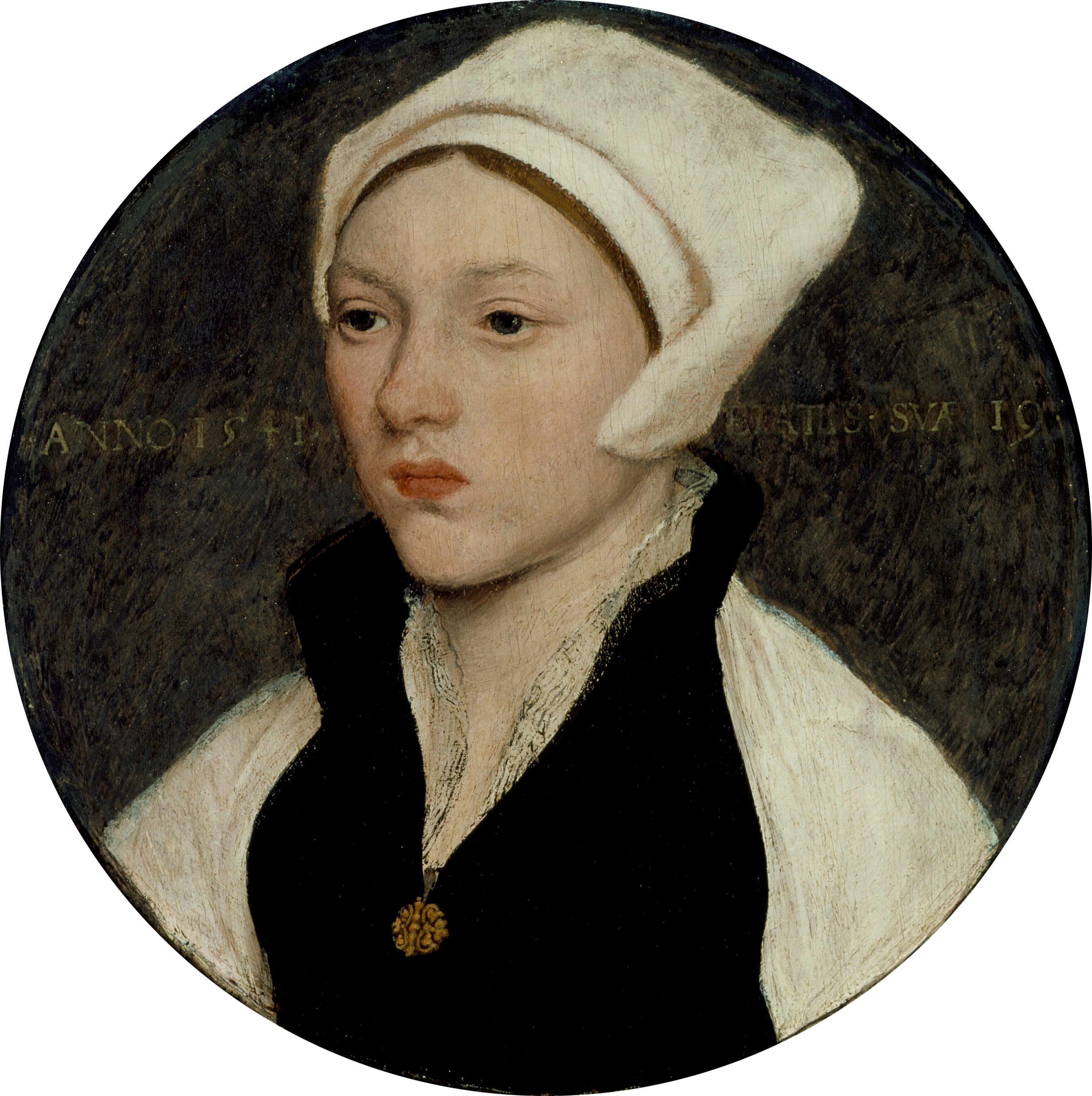
In most historical fiction set in the European Middle Ages, the female characters wear coifs.

4x5 original

(Painting: Hans Holbein)

But what exactly was a coif?

Coifs were various styles of close-fitting caps that covered the top, back, and sides of the head, holding the hair in place and away from the face.

In the Thirteenth Century coifs were worn by everyone, but they slowly fell out of fashion for men.  Women and children, however, continued using them well into the Seventeenth Century.  Not only were they a practical item for additional warmth in winter, they also provided a level of respectability for women and could be turned into a decorative status symbol for the nobility.

Up until the Tudor era, coifs were made from unadorned white linen and tied under the chin.  In Elizabethan and Jacobean times the hoods of the wealthy were made from silk.  They were often embroidered with elaborate Blackwork stitches.  Many had fancy lace edges.

Noble women’s coifs were usually wired to fit discretely under the current head fashions of the day.  They gradually became smaller to allow curls to flow down the back of the lady’s gown.

Workers and servants wore large, plain practical wraps that completely covered their hair.

Copyright © 2022 | KitPerriman.com | All Rights Reserved


Witch Test Seven

The Witch Test #7

The seventh test they’ll try is PRICKING THE WITCH!
If you’ve a birth mark, flea bite, spot, or scab – they’ll say it’s where the devil suckles.
It’s the sign of a pact made with Satan.
If they prick it, you’ll feel no pain, and neither will you bleed!

(Painting: Public Domain)

Copyright © 2022 | KitPerriman.com | All Rights Reserved