The Ancient Rushbearing Festival

Rushbearing.

Rushbearing

Rushbearing is an old Lancashire custom from the early Middle Ages that still survives in a few rural areas today.  It began as an annual Catholic festival to rededicate the local parish church, and soon developed into a day-long village celebration.  In olden times, the floors of churches were made of packed earth.  These were covered with rushes, herbs, and grasses to provide a sweet-smelling insulation against the cold and damp – a practice that continued until flagstones were finally installed.  One day a year, at the end of summer, or on the Saint’s Day associated with a particular church, the old rushes got swept away and new ones were put in their place.

Over time, this religious ceremony developed into a community festival that contained many carnival elements.  The rushes were harvested and dried out several weeks in advance, and then fashioned into a bee-hive decoration on the official rushbearing cart – a float also adorned with garlands and flowers.  The cart was traditionally pulled by all the young bachelors of the parish, and a village maiden chosen as the Rushbearing Queen rode on top.  The procession was often accompanied by banners, Morris Men, street performers, dancers, bands, and minstrels.

The day began with a slow progress through the crowded streets.  Those towns that did not use an official cart appointed several Rush Maidens instead, who carried a white sheet containing the new rushes.  Once they arrived at the church everyone ceremoniously helped to spread out the fresh flooring.  It was originally customary to ring the church bells, and to provide wine, ale and cake for the rushbearers – but the ceremony later developed into a day-long drunken revel, which unfortunately encouraged a lot of criminal activity.

By 1579, this festival had become so bawdy that Queen Elizabeth 1st outlawed the custom, disapproving of the drinking and frolicking taking place in local churchyards.  It was reestablished by King James 1st as part of the “diverting exercises” endorsed in his Book of Sports. 

Rushbearing can be seen each August at Newchurch-in-Pendle.  Other Lancashire towns have replaced the ceremony with similar village processions such as Club Day or Carnival Day.

Sources:

Ashworth, Elizabeth. Tales of Old Lancashire (Berkshire: Countryside Books, 2007)

Wiki: “Rushbearing” Accessed on 4/6/2015

(Painting: Public Domain)

Copyright © 2022 | KitPerriman.com | All Rights Reserved

Magic Or Medicine?

Magic Or Medicine?

Doctors / Physicians

Doctor   Hans Brock der Altere (c. 1584)

Throughout history, people have consulted doctors to diagnose and treat their ailments, but educated physicians were rare, expensive, and often dangerous. There was no understanding of how germs spread disease.  Indeed, well into the seventeenth century practitioners still followed Galen’s Greek notion that the body was made up of four humors – blood, phlegm, yellow bile, and black bile – and when one of these fluids got out of balance the body fell sick.  Leeches and blood-letting were common practices because fevers were thought to originate from having too much blood in the body.

Barber-surgeons

Quack  Franz Anton Maulbertsch (c. 1785)

The first barber-surgeons were monks who aided parishioners in their monasteries.  They often advocated a heavy dose of fasting and prayer to accompany their herbal remedies.

Later on, barber-surgeons  were found on battlefields tending the wounded.  In the age before anesthetics, surgery was considered a lowly occupation and these quacks performed many of the procedures that physicians refused to do, including barbaric amputations, teeth-pulling, enemas, and blood-letting for those who could not afford a physician.

Apothecaries

Apothecary

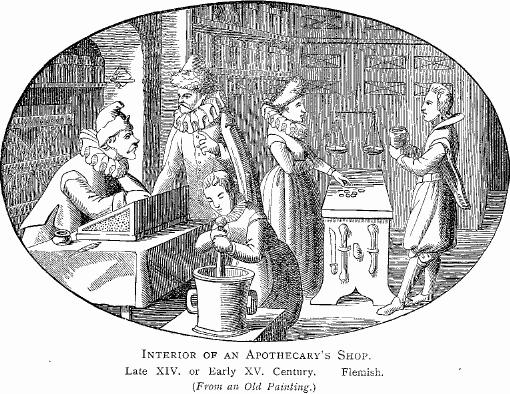
If a person knew what was wrong and merely required a cure, they could visit the apothecary.  These were early pharmacists who made medicines, salves, and potions, and also gave out advice on surgery and midwifery.  Their tonics consisted of herbs, minerals, animal parts, urine, honey, and a variety of fats.

Cunning Men and Wise Women

Cunning Folk

If you could not afford any of the above, a cure might be found with a folk-healer.  Cunning men and wise women used magic, prayer, herbal lore, and family experience to tackle the everyday ailments of the townsfolk, villagers, farmers, and their livestock.  They were cheaper than apothecaries and could be paid by trading goods instead of money.  The cunning folk also provided an array of services for specific problems that could be dealt with very discretely – contraceptive powders, abortion, love potions, impotence cures, and poisons.

Some of the more unfortunate – or unpopular – cunning folk got caught up in the witch hunts that swept across Europe throughout that period.  But when people began realizing these healers were not only useful, but necessary, new regulations appeared that differentiated between good magic and bad.  Lighter sentences were handed out – time spent in the pillory or jail – and capital punishment was only awarded to witches – those in league with demons, who conjured up devils or committed murder.

By the end of the Seventeenth Century extensive advancements had been made.  William Harvey discovered how the heart controls blood circulation in the body; Ambroise Pare made important breakthroughs for treating war wounds; Marcello Malpighi invented the microscope; and the first blood transfusions were carried out at the Royal Society in London.  But it took a great many years for these advancements to permeate throughout England.  In the meantime, the common people continued to pray and turn to the wise women for help!

(Pictures: Public Domain)

Copyright © 2022 | KitPerriman.com | All Rights Reserved

Boggarts and Bogeymen

Boggart

(Picture: Public Domain)

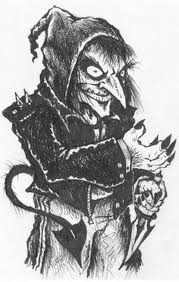
Boggarts have terrified English country-folk for hundreds of years.  Particularly feared in Lancashire,  they were said to haunt the fields, woods, and marshes – sometimes stealing away naughty children.  The term Boggart derives from the Middle English bug meaning ghost, hobgoblin, or object of terror (OED).

According to those who have seen these spirits, Boggarts come in many shapes and sizes.  Sometimes they appear as ugly humans, while others have described them as beast-like creatures.  Everyone, however, seems to agree that they are hairy, strong, have strange eyes, and sometimes resemble devils.

Tradition says that if a Boggart is given a name it becomes destructive and unreasonable, rather than simply mischievous.  Perhaps for this reason these sprites are often referred to generically as The Bogeyman. 

While they have sometimes been held accountable for poltergeist activity inside the home, Lancashire Boggarts prefer the outdoors – they scare people with eerie noises, overturn farm items, sour milk and ale, lame animals, and leave behind weird hoof-prints.  They also get blamed when children or travelers go missing.

So how do you ward off Boggarts and Bogeymen?

Stay away from the places they roam, especially at night.  And hang a horseshoe over the front door of the house – or leave a pile of salt outside your bedroom.

Sweet dreams!

Horseshoe The Golden Horseshoe (William Michael Harnett)

 Sources:

Wikipedia: “Boggarts” accessed 3/28/2015

The New Shorter Oxford English Dictionary (Oxford: Clarendon,1993)

Copyright © 2022 | KitPerriman.com | All Rights Reserved
The “Witch” Church

Newchurch

Newchurch-in-Pendle is an ancient village in the North of England, close to where several of the Lancashire Witches once lived and roamed.  It has been a religious center since Druid days, with the first Christian building appearing around 1250.  In 1544, a stone chapel was dedicated by the Bishop of Chester, possibly with the original tower.  Then a gallery was added in 1915, though the current St. Mary’s Church that stands here today has been restored and renovated many times since throughout the centuries.

Graveyard (2)

The most fascinating feature is the carving on the west face of the tower (under the clock face) – a large eye said to symbolize the all-seeing Eye of God.  In earlier years though, this may have been a talisman to ward off evil from the local cunning folk who were forced by law to attend services here every Sunday.  Today, St. Mary’s is also one of the few remaining churches that still celebrates the medieval Rushbearing Festival with a special service each August.

Graveyard (1)

The graveyard contains the headstones of many old families.  The Nutter plot (dated 1694) likely contains the  descendants of Alice Nutter, one of the witches executed in 1612.  From this consecrated soil, another witch – Old Chattox – supposedly stole twelve teeth that she later traded with her rival, Old Demdike.

In later times the village funeral processions were led by two black horses, and when these were spotted coming over Nanny Maud Hill the church bells began tolling The Passing Bell.

The Bone Room opens onto the graveyard, and for many years served as the Charnel House – a place where human remains were stored.  These were skeleton parts that had either been dug up by accident, or intentionally removed to make room in a plot for fresh bodies.

St. Mary’s Church is one of two major landmarks to have outlived the old belief in magic.  The other – providing its majestic backdrop – is the famous Pendle Hill.

Hill

(Photos: Kit Perriman)

Sources:

Clayton, John A.  A History of Pendle Forest and the Pendle Witch Trials (Lancashire: Barrowford Press, 2007)

Stansfield, Andy. The Forest of Bowland & Pendle Hill (Devon: Halsgrove House, 2006)

“St. Mary’s Church, Newchurch in Pendle.”  Wikipedia, accessed 3/23/2015

Copyright © 2022 | KitPerriman.com | All Rights Reserved

Brighid: Goddess and Saint

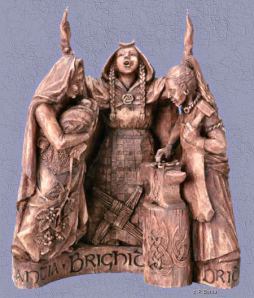
The Wise Women of Britain had their own special patron – the goddess Brighid – who later became known as Saint Brigit.  She was a Celtic pagan deity, the equivalent of Roman Minerva and Greek Athene, whose name meant exalted one.  In Irish mythology, Brighid was the daughter of Dagda, wife of Bres, and the mother of Ruadan – the son she invented keening for when he died in battle.

Brighid

Brighid was one of three sisters (all named Brighid) who jointly made up the Triple Deity – maiden, mother, crone.  For many years she was closely associated with Wise Women and became the goddess of healers and magicians.  Called on for assistance with prophecy and divination, Brighid represented wisdom, intelligence, excellence, perfection, craftsmanship, artistry, healing, and druidic knowledge.  Because she protected pregnant women and aided in childbirth, she was also connected with the hearth and home.

At some point in the Middle Ages the Catholic Church syncretized Brighid into the Christian St. Brigit of Kildare, making her the keeper of the eternal flame (from her former role of protecting Druid priestesses) and tender of holy healing wells (as she was already widely associated with medicine).  Her festival day at the start of February marks the arrival of spring, but instead of being called Imbolc it then became known as St. Brigit’s Day instead.

Brighid is the patron saint of poetry, blacksmithing, arts and crafts, cattle, and serpents.  She is credited with inventing the whistle.  Her symbols include the hearth, cauldron, forge, and bridal bed.  Corn dolls, crosses, and knots have been named after her, and she is connected with cats, foxes, cows, bees, and wrens.

Corn Doll

The last time I visited St. Mary’s Church at Newchurch-in-Pendle I was delighted by the collection of rush decorations nailed along the walls, carefully fashioned into crosses, knots, and dollies.

The old traditions die hard!

(Photos: Public Domain)


Sources:

Lockhart, Elaine. “Brighid: A Personal Relationship” in Modern Witch,  First Issue, Imbolc, 2012 (p8-9)

About Religion. “Brighid: Hearth Goddess of Ireland.” Available at http://paganwiccan.about.com/od/godsandgoddesses/p/Brighid_Profile.htm (2/25/2015)

Wikipedia:  “Brigid”

Copyright © 2022 | KitPerriman.com | All Rights Reserved
In The Beginning . . .

Throughout the Middle Ages,Lancashire was ripe with tales of cunning folk.  In 1595 a conjure man called John Hartley convinced the Starkies of Huntroyde that seven members of their household were possessed by demons.  The Starkies were related to Roger Nowell, a Justice of the Peace from nearby Read who spearheaded the infamous Lancashire Witch Hunts of 1612.

Devil

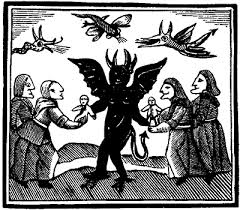
King James 1st became ruler of England in 1603 – the same year Jennet Device was born into the Demdike Clan at Malkin Tower – and the same year that a terrible plague swept the land.  Two years later Guy Fawkes’ Jesuit Gunpowder Plot failed to blow up Parliament, but it did trigger a nation-wide persecution of priests at a time when Lancashire was still a Catholic stronghold.

Witches, ghosts, and boggarts were a part of English folklore, inspiring many weird and wonderful tales that included Shakespeare’s Macbeth (1606).  The wise women of Pendle Hill worked the superstitious locals to eke out a meager living.  They offered a wide range of services from basic herbal medicine to midwifery and abortion – concocting charms, curses, love spells, and potions – claiming they could heal, harm, and foretell the future.

On March 21st in 1612, Old Demdike’s teenage granddaughter – Alizon Device – set off to go begging in Colne.  On the way she met a peddler called John Law who refused to give her the pins she demanded and so she cursed him.  Moments later Law collapsed, paralyzed down one side of his body.  He pointed the finger at Alizon Device and his son went straight to the authorities.  Because Alizon was one of the notorious Demdikes the rest of her family were rounded up for examination and before long, the Lancashire Witch Hunts had begun.

(Drawing: Public Domain)

Copyright © 2022 | KitPerriman.com | All Rights Reserved