“It’s easier to curse the darkness than to light a candle!”

(Traditional Wisdom)
(Photo: Kit Perriman)
Copyright © 2022 | KitPerriman.com | All Rights Reserved
“It’s easier to curse the darkness than to light a candle!”
(Traditional Wisdom)
(Photo: Kit Perriman)
Copyright © 2022 | KitPerriman.com | All Rights Reserved
Samhain, Halloween, All Hallows Eve, or Souls Night
Call it what you will, but the veil between the worlds is at its thinnest on October 31st.
Samhain means Summer’s End. Wise Women used to celebrate on the nearest full moon before November, after the harvest was gathered, halfway between Autumn Equinox and the Winter Solstice. This date represented the end of summer and the start of the spiritual New Year. Samhain came from the Celtic Fire Festival when the Druids remembered their dead. Bonfires were built to cleanse and protect, and sacrifices were offered to the gods. It was a night of divination, mummers, feasting, guising, and young lads following the Hobby Horse about the village.
The Church of Rome turned this feast into All Hallows’ Eve, the start of All Saints’ Day to honor the Christian saints and martyrs. Soul Cakes got eaten instead of meat. Candles were lit for the dear departed and there were vigils, feasts, and the ringing of church bells everywhere.
Youngsters, in particular, enjoyed celebrating Halloween, short for Hallowed or Holy Evening. They remembered the frailty of life with skeletons, ghouls, cobwebs, tombstones, and demons, hoping to chase evil and death away by honoring the darkness. Some carved turnips into Jack o’ Lanterns for those lost souls who’ve been denied both Heaven and Hell, while others partook in pranks to imitate mischievous spirits, costume feasts, processions, and mummers’ plays.
When the Puritans colonized America they introduced the concept of Halloween in the United States. Private costume parties were held to celebrate and protect the harvest. Over time, pumpkins replaced turnips; Irish immigrants introduced “trick-or-treating”; and candy, costume, and greeting card companies began actively promoting this festival as a national holiday to increase their sales. Halloween has now become one of the most popular celebrations on both sides of the Atlantic.
It’s a powerful time – so be careful and guard your own soul!
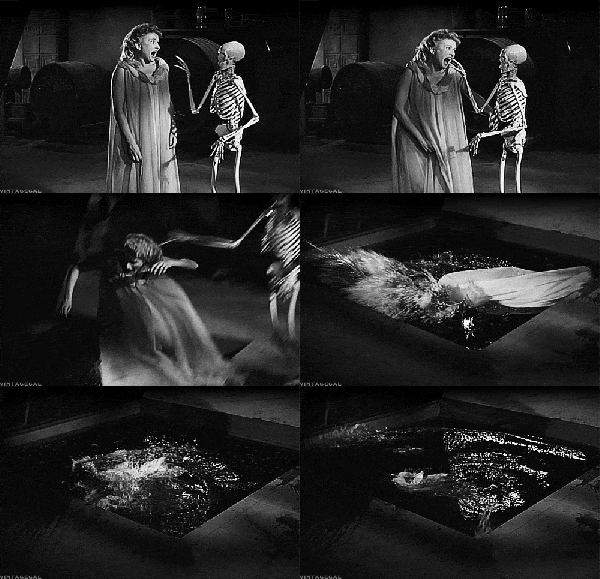
(GIF: Public Domain)
Copyright © 2022 | KitPerriman.com | All Rights Reserved
 “The phrase domestic cat is an oxymoron” (George F. Will)
Ever since hunting communities turned to farming, the advantages of keeping cats around was obvious – they kept down the rodents that ate the precious grain supplies. As cats became more domesticated people grew fond of these playful balls of mischief and started making them pets. Cats were revered by the Egyptians, Chinese, Japanese, Indians, Romans, and Vikings for hundreds of years. If a black cat crossed your path you would be lucky, and to dream of this creature was a good omen. Mummified cats were buried in houses as a spiritual protection against rats and mice. But something happened in the Middle Ages that changed public opinion so that cats suddenly became demonized and were actively persecuted. Why did this happen?

The cat is an ambivalent creature, wild by nature and perhaps never fully tamed. They are not easily befriended, roam about in the night, and are sexually promiscuous. Cats are stealthy, sneaky, silent, clever, inquisitive, and almost invisible in the darkness – except for their scary eyes. All felines are hunters and killers, and their eerie howls and cries can sound quite chilling. They are said to have nine lives and be difficult to get rid of. And some old wives’ tales claim cats kill babies – either by sitting on their faces or by sucking the breath from their noses.
The Celts believed cats were the souls of wicked people unfit to be reborn as humans who were changed into animals instead. Perhaps this notion of evil lived on in the European psyche because when the early medieval witch hunts broke out, common animals became firmly associated with witches – particularly black cats. Cats were said to be their familiar spirits. Felines were seen as either shape-shifting witches or devils in disguise, or as the bad souls of former witches reborn. In 1484, a Papal decree denounced all cats and their owners as devil-worshippers, opening the floodgates for The Burning Times to begin.
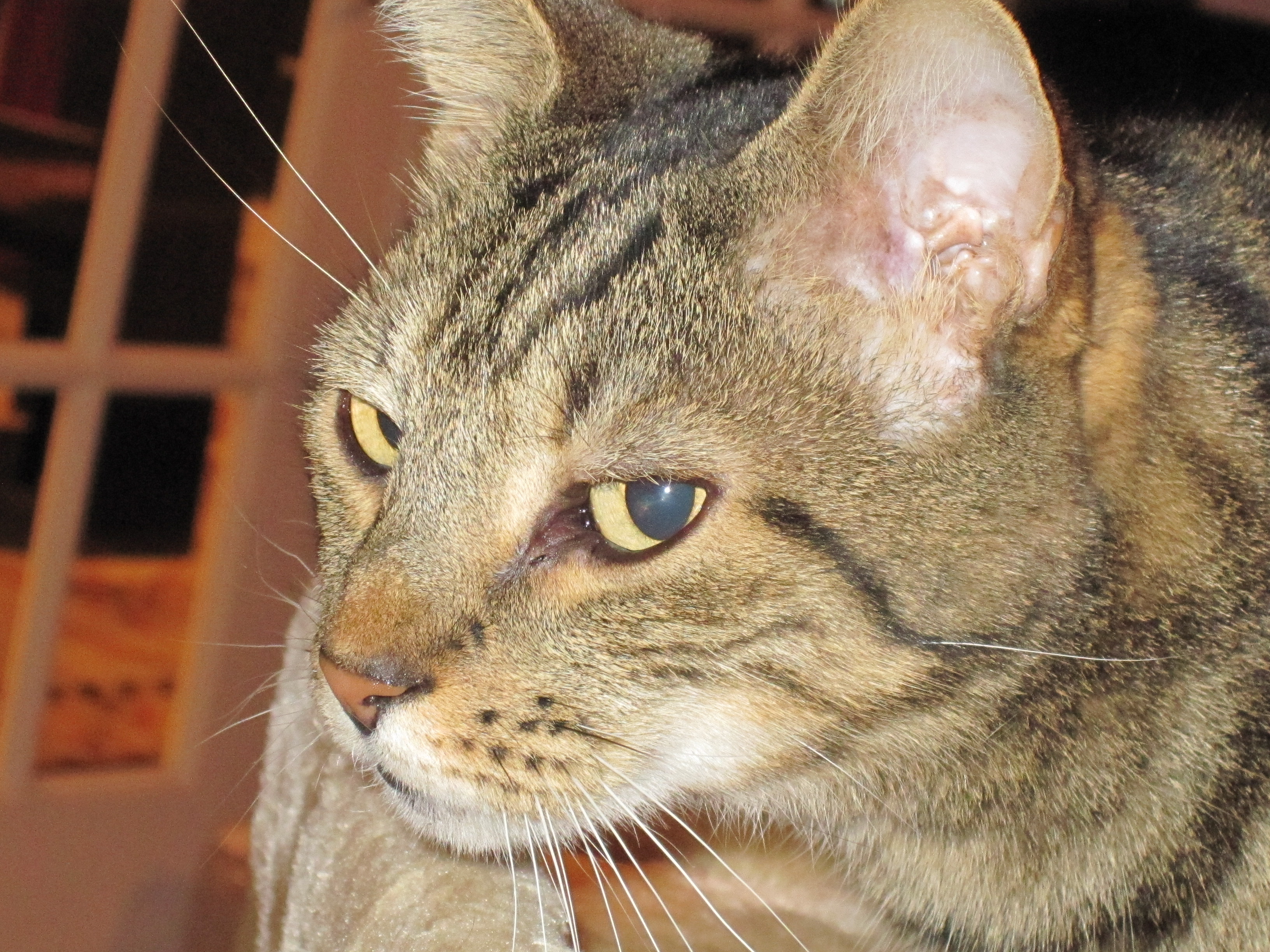
This persecution lasted hundreds of years. And just as the cunning folk were condemned to terrible deaths, so too were their pets. Thousands of cats were hunted down during Lent and burned on huge public bonfires. At the coronation of Queen Elizabeth I (1558) live cats were stuffed inside a wicker effigy of the pope and set ablaze. It is said that loud songs and music were used to drown out their pitiful howls, but no one spoke out against the atrocity because cats were the most feared and reviled of all common animals.
The Age of Enlightenment gave rise to a more logical and scientific way of thinking that eventually overcame these fears and superstitions. And when people started questioning the existence of witchcraft they began seeing cats through different eyes too. They were no longer the public enemy.
As a life-long cat owner I have grown to appreciate the independence and intriguing ambiguities of my kitties, but if yours ever lets you think they are truly domesticated – enjoy the illusion!
(Photos: Kit Perriman)
Copyright © 2022 | KitPerriman.com | All Rights Reserved
Kit’s Crit: The Hour of the Witch (Chris Bohjalian)

After the young Mary Deerfield moves to Boston, she becomes the new second-wife of an abusive Puritan widower called Thomas Deerfield. Thomas likes to drink and pick arguments with his woman. One such night he attacks Mary with a fork, badly damaging her hand – but she has grown weary of trying to hide her bruises from family and friends and decides the time has come to divorce her husband on the grounds of cruelty.
The patriarchy close ranks and force her to stay in a dangerous, loveless marriage. Things escalate from bad to worse until Mary is forced to seek help from the local wise women and ultimately finds herself on trial for witchcraft. She is pronounced guilty and sentenced to hang.
The Hour of the Witch is well-researched, nicely paced, and skillfully written. The only time I detected a male writer was in one of the early sex scenes, although the rest of the story is convincing and engaging. In summary, this is one of the finest historical fiction witch books published to date.
Copyright © 2022 | KitPerriman.com | All Rights Reserve
Since 1093, Lancaster Castle has protected the north of England from a Scottish invasion. Built on the site of an old Roman fort, it was confiscated by the Crown following an unsuccessful rebellion against King Henry I. Today it belongs to Her Majesty, Queen Elizabeth II.
Lancaster Castle has a long history of dealing with criminals. The first Assizes (law courts for serious cases) began in 1166 and were held twice each year. And although the castle is still used as a Crown Court today, it recently stopped serving as a prison in March, 2011.
 The trials of the Lancashire Witches took place within these walls on two days of August, 1612. According to local legend the prisoners endured horrific conditions while imprisoned in the dungeons of the Well Tower. One of the matriarchs – Old Demdike – did not survive her incarceration. It is also estimated that around 200 official executions took place here over the centuries.
Lancaster Castle is a fascinating tourist attraction for anyone interested in medieval history, crime and punishment, witch hunts, religious persecutions, and British heraldry. Yet children growing up in the area were told, No one comes out of that place the same way they went in – most of the prisoners supposedly turned mad.
Today, the gray, daunting castle still dominates the quaint city of Lancaster from its perch on the top of the hill.
And within its chilly walls lie many dark, unspoken wonders.
Source Material:
Champness, John. Lancaster Castle: A Brief History (Lancashire: Lancashire County Books, 1993)
(Photo: Public Domain)
Copyright © 2022 | KitPerriman.com | All Rights Reserved
Waking the Witch

Waking the Witch is a well-researched and entertaining history of witches, from ancient times to the present day. Author Pam Grossman hosts the podcast The Witch Wave, and in this mix of scholarship and memoir she examines the enduring connections between female power and patriarchal persecution.
Grossman also explores the myth and martyr, sister and scary monster, feminine and feminist, interpreting what it means to both practice magic, and to be accused of practicing magic in less tolerant societies. She also highlights how the word craft is used for “both making art and doing magic . . . . Artists use the power of imagination to create pieces that shift consciousness, thereby changing both the maker and the viewer,” as do potent spells [188]. She suggests that creative people have sprinkled their own individual magic in the world all throughout history.
This book is beautifully written and accessible to a wide audience on many different levels. Very informative, witty, and enjoyable!
(Photo: Kit Perriman)
Copyright © 2022 | KitPerriman.com | All Rights Reserved
There are few place in England older, or more shrouded in mystery, than Stonehenge. The famous stones in Wiltshire have aroused much speculation throughout the centuries – that they were built by alien gods – conjured up by Merlin – designed by the Druids for ritual sacrifices – or were part of a mystical system of Ley Lines. This magic circle still draws thousands of tourists every year from all parts of the globe. It is a place of natural energy and stunning design.

(Photo: Public Domain)
But there is another place of wonder in the North of Britain, far more ancient and equally fascinating, called Pendle Hill. Almost the size of a mountain, it rises 1,829′ above sea level in the Pennine Range, separating the ancient seats of Lancaster (Lancashire) and York (Yorkshire).

(Photo: Kit Perriman)
The hill is a place of stark, feral beautiful, often mysteriously shrouded in mist. A Bronze Age burial site has been discovered on the summit, and it is said that the Druids once lived close by. For as long as men and women worshipped the rising sun there have been celebrations on this thirsty earth, a soil demanding human blood. There are rumors of wicker-man sacrifices – fertility rites to bring in the spring – priestesses who could raise storms and conquer invading enemies. Even the great Julius Caesar admitting to fearing these weird conjurers.
Although little of Pendle’s history is certain before the Norman Conquest, the land was then given to the De Laceys and they established two “royal” hunting grounds, one in the Forest of Pendle and the other in the Forest of Trawden. Throughout the Middle Ages this area was a center for sheep farming and wool production, and despite Henry VIII’s Reformation the people clung to their old beliefs – probably a little Celtic paganism mixed with Catholic ritual and a hefty dose of superstition.
It is still an awesome place today. From the top of the cairn you can often see as far as the sea. The air tingles with a hidden current, like the pulse of an ancient heartbeat. This peculiar energy cannot be explained but it has been interpreted in two important, yet widely opposing ways. In 1652 George Fox climbed to the top of Pendle Hill and had a vision of many souls coming to Christ. This compelled him to start the Quaker Movement and dedicate his life to the service of God.
A few years earlier, however, this same land was thought to be riddled with witches and demons, which triggered the Lancashire Witch Trials of 1612 and 1634.
If you are ever in Lancashire, it is well worth a visit!
Copyright © 2022 | KitPerriman.com | All Rights Reserved
MAGIC IS SPIRITUAL –

WITCHCRAFT IS POLITICAL
(GIF from animatedimages.org)
Copyright © 2022 | KitPerriman.com | All Rights Reserved
The Divine Comedy is an epic poem written by Dante Alighieri between 1308-1320 AD. As one of the most influential books ever composed, this religious allegory about the importance of salvation marks the start of Italian literature.
The story begins at Easter in the year 1300. There are three parts (cantiche) – aligning with the Trinity’s Father Son, and Holy Ghost. They are entitled Hell (Inferno), Purgatory (Purgatorio) and Heaven (Paradiso). Each section has 33 Songs (cantos), except for the first part which has 34. These add up to a total of 100 Songs to represent Dante’s “perfect” number 10 (10 x 10 = 100).
Written in the first person, Dante imagines his soul’s spiritual quest as it ventures from darkness into light.
 (Salvador Dali)
“Midway on our life’s journey, I found myself
In dark woods, the right road lost . . .”
The narrator wakes up one day to find himself in the dark forest of sin. The spirit of Virgil appears and promises to lead him on the path of salvation through Hell, Purgatory, and into Heaven. Virgil eventually hands him over to Beatrice (the ideal woman).
Dante’s world is full of monsters and demons. Each soul is punished according to its former deeds, which range from small self-indulgent transgressions such as a lack of willpower. to violent and malicious crimes. Hell is portrayed as an underground funnel made up of circles. At the bottom sits Satan who perpetually gnaws on history’s three worst traitors: Judas, Brutus, and Cassius. The punishments inflicted on the travelers are vivid and relentless – the stuff of eternal nightmares. Yet those sinners who have confessed to their crimes before death are eventually permitted to leave Hell and head through Purgatory in search of Heaven.
Purgatory is a mountain made up of 7 rings, with the Garden of Eden at the top. Once cleansed of their sins, the wandering souls rise up toward Heaven where God appears as a vision of light.
Dante’s morality poem is a tale of justice and retribution. The wrong-doers are punished for their past crimes with the worst torments imaginable. They have to suffer alone and abandoned, devoid of help or hope.
![Cerberus_Gluttony[1]](https://kitperrimanthehill.com/wp-content/uploads/2015/12/cerberus_gluttony1.jpg?w=300)
So why is this classic called The Divine Comedy when it is a full-blown scary vision of Hell? Because Dante’s epic has a happy ending and therefore is not considered a tragedy in the standard literary tradition.
Sleep well!
(Paintings: Public Domain)
Copyright © 2022 | KitPerriman.com | All Rights Reserved
Matthew Hopkins (c. 1620-1647) was the self-appointed Witch-finder General of the English Civil War era. He worked mainly in the East Anglia region.
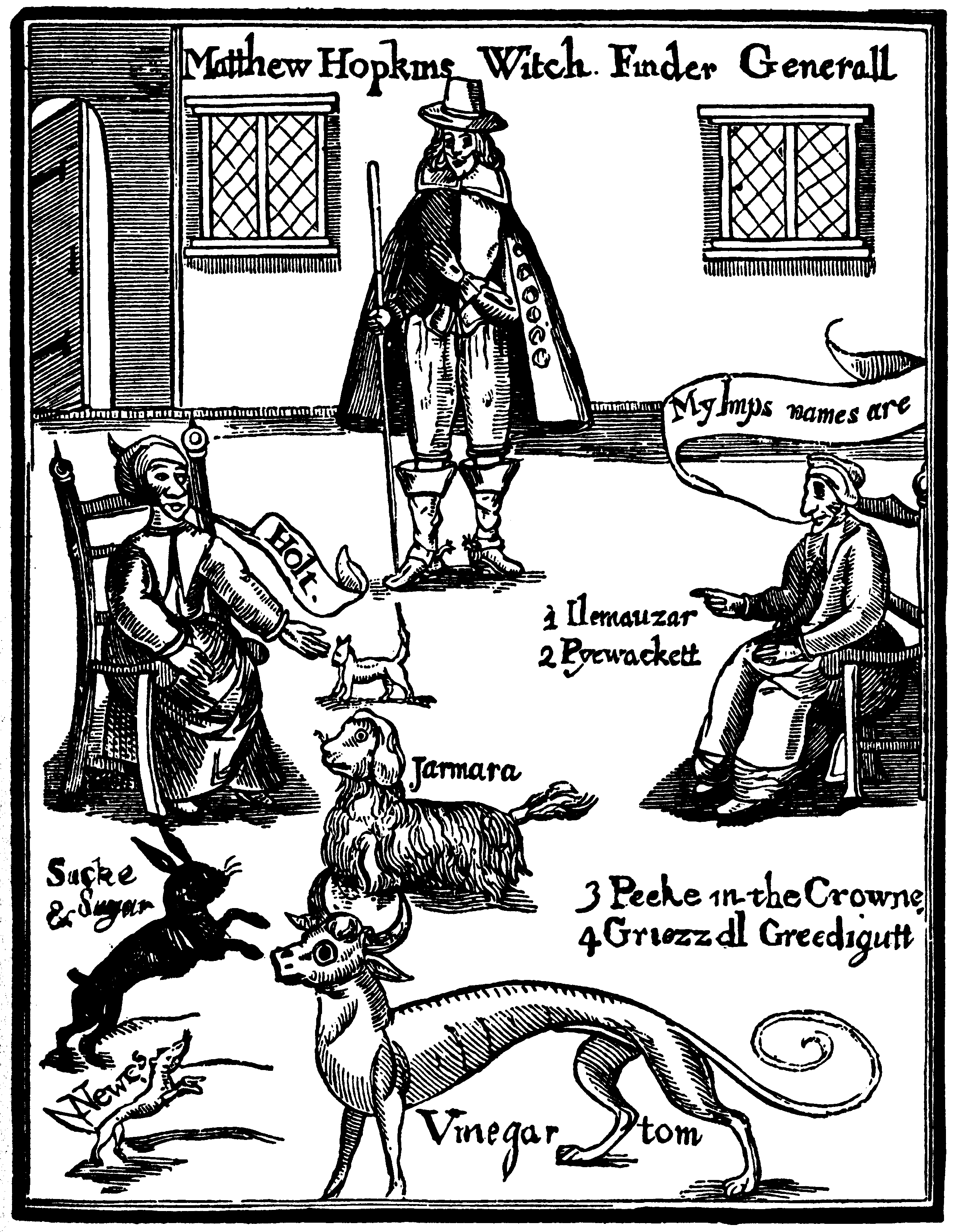 Hopkins, the son of a Puritan clergyman from Suffolk, operated with a man called John Stearne. Several women “prickers” also travelled around the countryside with them, going from town to town to identify those in league with Satan. Although the Witch-finders were only active for three years (1644-1647) they were responsible for accusing approximately 300 women – more witches than England had executed in the previous hundred years!
Hopkins found employment as a direct result of the second Lancashire Witch Trials of 1634, whereby King Charles personally investigated the case and finally pardoned all of the prisoners. Thereafter, he demanded a confession, or material proof of a crime, before sentencing a suspect to death.
As Hopkins was paid for the witches he uncovered, he developed his own methods to comply with the royal demand. Torture was illegal – but the Witch-finder General used sleep deprivation, ducking (or swimming) witches, bleeding, and the test of pricking the Devil’s Mark. Rumor claims that Hopkins invented a bodkin with a retractable blade. This looked like it was piercing the skin but in fact it made no impact. Because the prisoners felt no pain, and did not bleed, they were deemed to be sorcerers.
In 1647 Hopkins published a pamphlet called The Discovery of Witches, but a campaign against his cruel methods had already been triggered by John Gaule, a vicar in Huntingdonshire. As public opinion changed, the Witch-finder’s credibility dwindled and his team was forced into retirement. He died in 1647, probably from tuberculosis.
According to local legend, Matthew Hopkins’ ghost haunts Mistley Pond — a spot in Suffolk close to where he was buried. It is said that he still roams the land in search of witches!
(Drawing: Public Domain)
Sources
BBC Legacies. “Witch-finder Witch?” at http://www.bbc.co.uk/legacies/myths_legends/england/essex/article_4.shtml
Controverscial. “Matthew Hopkins,” at http://www.controverscial.com/Matthew%20Hopkins.htm
Encyclopedia Britannica. “Matthew Hopkins,” at http://www.britannica.com/biography/Matthew-Hopkins
Wikipedia. “Matthew Hopkins,” at https://en.wikipedia.org/wiki/Matthew_Hopkins
Copyright © 2022 | KitPerriman.com | All Rights Reserved
 Kit Perriman