Lancaster Castle

Since 1093, Lancaster Castle has protected the north of England from a Scottish invasion.  Built on the site of an old Roman fort, it was confiscated by the Crown following an unsuccessful rebellion against King Henry I.  Today it belongs to Her Majesty, Queen Elizabeth II.

Lancaster Castle has a long history of dealing with criminals.  The first Assizes (law courts for serious cases) began in 1166 and were held twice each year.  And although the castle is still used as a Crown Court today, it recently stopped serving as a prison in March, 2011.

CastleThe trials of the Lancashire Witches took place within these walls on two days of August, 1612.  According to local legend the prisoners endured horrific conditions while imprisoned in the dungeons of the Well Tower.  One of the matriarchs – Old Demdike – did not survive her incarceration.  It is also estimated that around 200 official executions took place here over the centuries.

Lancaster Castle is a fascinating tourist attraction for anyone interested in medieval history, crime and punishment, witch hunts, religious persecutions, and British heraldry.  Yet children growing up in the area were told, No one comes out of that place the same way they went in – most of the prisoners supposedly turned mad.

Today, the gray, daunting castle still dominates the quaint city of Lancaster from its perch on the top of the hill.

And within its chilly walls lie many dark, unspoken wonders.

Source Material:

Champness, John.  Lancaster Castle: A Brief History (Lancashire: Lancashire County Books, 1993)

(Photo: Public Domain)

Copyright © 2022 | KitPerriman.com | All Rights Reserved

Kit’s Crit: Waking the Witch (Pam Grossman)

Waking the Witch

Waking the Witch is a well-researched and entertaining history of witches, from ancient times to the present day. Author Pam Grossman hosts the podcast The Witch Wave, and in this mix of scholarship and memoir she examines the enduring connections between female power and patriarchal persecution.

Grossman also explores the myth and martyr, sister and scary monster, feminine and feminist, interpreting what it means to both practice magic, and to be accused of practicing magic in less tolerant societies. She also highlights how the word craft is used for “both making art and doing magic . . . . Artists use the power of imagination to create pieces that shift consciousness, thereby changing both the maker and the viewer,” as do potent spells [188]. She suggests that creative people have sprinkled their own individual magic in the world all throughout history.

This book is beautifully written and accessible to a wide audience on many different levels. Very informative, witty, and enjoyable!

(Photo: Kit Perriman)

Copyright © 2022 | KitPerriman.com | All Rights Reserved

The Hill

There are few place in England older, or more shrouded in mystery, than Stonehenge.  The famous stones in Wiltshire have aroused much speculation throughout the centuries – that they were built by alien gods – conjured up by Merlin – designed by the Druids for ritual sacrifices – or were part of a mystical system of Ley Lines.  This magic circle still draws thousands of tourists every year from all parts of the globe.  It is a place of natural energy and stunning design.

Stonehenge

(Photo: Public Domain)

But there is another place of wonder in the North of Britain, far more ancient and equally fascinating, called Pendle Hill.  Almost the size of a mountain, it rises 1,829′ above sea level in the Pennine Range, separating the ancient seats of Lancaster (Lancashire) and York (Yorkshire).

Hill

                                                                                                                                                                                                              (Photo: Kit Perriman)

The hill is a place of stark, feral beautiful, often mysteriously shrouded in mist.  A Bronze Age burial site has been discovered on the summit, and it is said that the Druids once lived close by.  For as long as men and women worshipped the rising sun there have been celebrations on this thirsty earth, a soil demanding human blood.  There are rumors of wicker-man sacrifices – fertility rites to bring in the spring – priestesses who could raise storms and conquer invading enemies.  Even the great Julius Caesar admitting to fearing these weird conjurers.

Although little of Pendle’s history is certain before the Norman Conquest, the land was then given to the De Laceys and they established two “royal” hunting grounds, one in the Forest of Pendle and the other in the Forest of Trawden.  Throughout the Middle Ages  this area was a center for sheep farming and wool production, and despite Henry VIII’s Reformation the people clung to their old beliefs – probably a little Celtic paganism mixed with Catholic ritual and a hefty dose of superstition.

It is still an awesome place today.  From the top of the cairn you can often see as far as the sea.  The air tingles with a hidden current, like the pulse of an ancient heartbeat.  This peculiar energy cannot be explained but it has been interpreted in two important, yet widely opposing ways.  In 1652 George Fox climbed to the top of Pendle Hill and had a vision of many souls coming to Christ. This compelled him to start the Quaker Movement and dedicate his life to the service of God.

A few years earlier, however, this same land was thought to be riddled with witches and demons, which triggered the Lancashire Witch Trials of 1612 and 1634.

If you are ever in Lancashire, it is well worth a visit!

Copyright © 2022 | KitPerriman.com | All Rights Reserved

The Divine Comedy: Dante’s Demons

The Divine Comedy is an epic poem written by Dante Alighieri between 1308-1320 AD.  As one of the most influential books ever composed, this religious allegory about the importance of salvation marks the start of Italian literature.

The story begins at Easter in the year 1300.  There are three parts (cantiche) aligning with the Trinity’s Father Son, and Holy Ghost.  They are entitled Hell (Inferno), Purgatory (Purgatorio) and  Heaven (Paradiso).  Each section has 33 Songs (cantos), except for the first part which has 34.  These add up to a total of 100 Songs to represent Dante’s “perfect” number 10 (10 x 10 = 100).

Written in the first person, Dante imagines his soul’s spiritual quest as it ventures from darkness into light.

Dali 1 (Salvador Dali)

“Midway on our life’s journey, I found myself

In dark woods, the right road lost . . .”

The narrator wakes up one day to find himself in the dark forest of sin.  The spirit of Virgil appears and promises to lead him on the path of salvation through Hell, Purgatory, and into  Heaven.  Virgil eventually hands him over to Beatrice (the ideal woman).

Dante’s world is full of monsters and demons.  Each soul is punished according to its former deeds, which range from small self-indulgent transgressions such as a lack of willpower. to violent and malicious crimes.  Hell is portrayed as an underground funnel made up of circles.  At the bottom sits Satan who perpetually gnaws on history’s three worst traitors: Judas, Brutus, and Cassius.  The punishments inflicted on the travelers are vivid and relentless – the stuff of eternal nightmares.  Yet those sinners who have confessed to their crimes before death are eventually permitted to leave Hell and head through Purgatory in search of Heaven.

Purgatory is a mountain made up of 7 rings, with the Garden of Eden at the top.  Once cleansed of their sins, the wandering souls rise up toward Heaven where God appears as a vision of light.

Dante’s morality poem is a tale of justice and retribution.  The wrong-doers are punished for their past crimes with the worst torments imaginable.  They have to suffer alone and abandoned, devoid of help or hope.

Cerberus_Gluttony[1]

So why is this classic called The Divine Comedy when it is a full-blown scary vision of Hell?  Because Dante’s epic has a happy ending and therefore is not considered a tragedy in the standard literary tradition.

Sleep well!

(Paintings: Public Domain)

Copyright © 2022 | KitPerriman.com | All Rights Reserved

The Witch-finder General

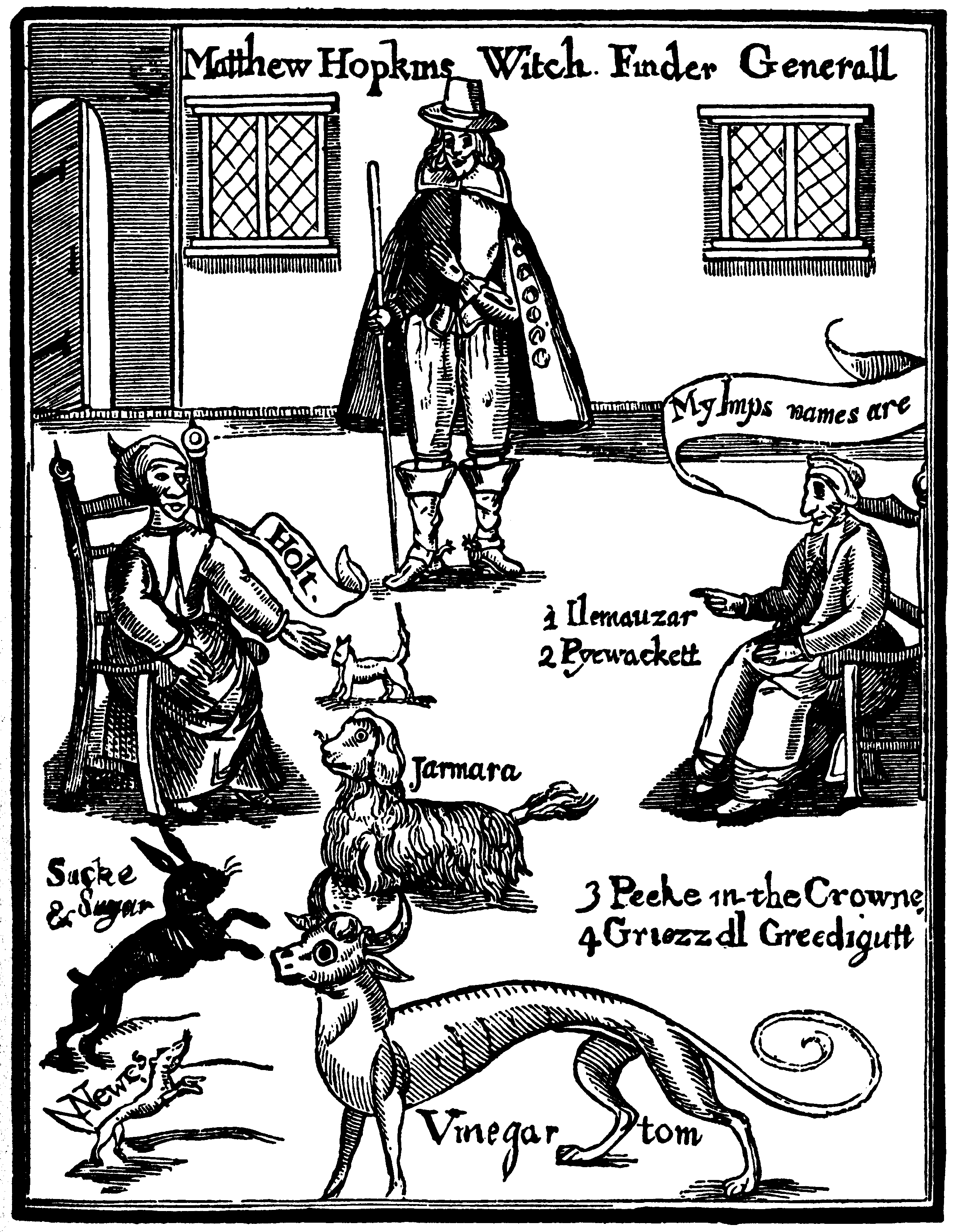
Matthew Hopkins (c. 1620-1647) was the self-appointed Witch-finder General of the English Civil War era.  He worked mainly in the East Anglia region.

Hopkins Hopkins, the son of a Puritan clergyman from Suffolk, operated with a man called John Stearne.  Several women “prickers” also travelled around the countryside with them, going from town to town to identify those in league with Satan.  Although the Witch-finders were only active for three years (1644-1647) they were responsible for accusing approximately 300 women – more witches than England had executed in the previous hundred years!

Hopkins found employment as a direct result of the second Lancashire Witch Trials of 1634, whereby King Charles personally investigated the case and finally pardoned all of the prisoners.   Thereafter, he demanded  a confession, or material proof of a crime, before sentencing a suspect to death.

As Hopkins was paid for the witches he uncovered, he developed his own methods to comply with the royal demand.  Torture was illegal – but the Witch-finder General used sleep deprivation, ducking (or swimming) witches, bleeding, and the test of pricking the Devil’s Mark.  Rumor claims that Hopkins invented a bodkin with a retractable blade.  This looked like it was piercing the skin but in fact it made no impact.  Because the prisoners felt no pain, and did not bleed, they were deemed to be sorcerers.

In 1647 Hopkins published a pamphlet called The Discovery of Witches, but a campaign against his cruel methods had already been triggered by John Gaule, a vicar in Huntingdonshire.  As public opinion changed, the Witch-finder’s credibility dwindled and his team was forced into retirement.  He died in 1647, probably from tuberculosis.

According to local legend, Matthew Hopkins’ ghost haunts Mistley Pond — a spot in Suffolk close to where he was buried.  It is said that he still roams the land in search of witches!

(Drawing: Public Domain)

Sources

BBC Legacies. “Witch-finder Witch?” at http://www.bbc.co.uk/legacies/myths_legends/england/essex/article_4.shtml

Controverscial. “Matthew Hopkins,” at http://www.controverscial.com/Matthew%20Hopkins.htm

Encyclopedia Britannica. “Matthew Hopkins,” at http://www.britannica.com/biography/Matthew-Hopkins

Wikipedia. “Matthew Hopkins,” at https://en.wikipedia.org/wiki/Matthew_Hopkins

Copyright © 2022 | KitPerriman.com | All Rights Reserved

Tituba the Witch

TitubaandtheChildren-Fredericks[1]

Tituba was the first person examined in the Salem Witch Trials of 1692, and was possibly the only true witch.  She learned the Craft from her mistress in Barbados and likely practiced some form of Voodoo.

Although Tituba was a woman of color there is some debate whether she was African West Indian, Native American, or of mixed heritage.  In the court documents she is listed as an “Indian Woman, Servant.”  She may have been an Arawak Indian from South America who was captured as a child, enslaved in Barbados, and sold to Samuel Parris as a teenager between the ages of 12-17 years old.  Parris brought her to Boston in 1680, along with another slave called John Indian whom she later married.  They had one child called Violet.  During the next few years Parris became a minister,started his own family, and moved his household to Salem in 1689.

What sparked the Salem witch hunts?  Many theories have been offered over the years, but the trigger appears to have been a group of Puritan girls who were bored and yearned for “sport.”  During a particularly harsh winter, when they were often confined to their small houses for long stretches of time, their curiosity was peaked by Tituba’s supernatural tales.  At that time in New England there was also a widespread interest in fortune-telling, which was forbidden.  Two of the girls read fortunes from an egg white in a glass of water, and when they started acting out and having fits  Elizabeth “Betty” Parris and Abigail Williams blamed Tituba as the cause.

The Reverend Parris beat Tituba until she confessed to making a witch cake with Mary Sibley.  And before long, her superstitious ramblings had convinced the people of Salem that Satan was among them. Tituba talked of riding on broomsticks and claimed she saw one of the villagers –  Sarah Osborne – with a winged female demon.  Her accusations led to an outbreak of mass hysteria that ended in the execution of 20 people.

Strangely enough, Tituba was one of the survivors.  Because she had already admitted to being a witch she never went to trail.  Instead, she was placed in jail.  No one knows where she went after her release but it seems likely she was sold to another owner.

Or perhaps the only true witch escaped because she knew a good protection spell!  What do you think?

(Drawing: Public Domain)

Sources:

Barillari, Alyssa. “Tituba,” at http://salem.lib.virginia.edu/people/tituba.html

“Tituba,” at http://law2.umkc.edu/faculty/projects/ftrials/salem/ASA_TIT.HTM

Wikipedia. “Tituba,” at https://en.wikipedia.org/wiki/Tituba_(Salem_witch_trials)

Copyright © 2022 | KitPerriman.com | All Rights Reserved

Abracadabra!

  • Abracadabra is the famous magical word that is still used today by stage conjurers.
  • It may have derived from an ancient Jewish cure for sickness that went:

Ab Abr Abra Abrak Abraka

Abrakal Abrakala Abrakal

Abraka Abrak Abra Abr Ab

  • Another theory is that it came from the followers of Basilides who worshipped a god called Abraxas.   He ruled the 365 days of the year. The 7 letters of his name may represent the 7 astrological planets that control fate.
  • The first recorded use of Abracadabra was made by Quintus Serenus Sammonicus, who was the doctor of the Roman Emperors Caracalla, Geta, and Severus.  In 208 AD he accompanied Emperor Severus on his expedition to Britain.
  • The word was used as a healing charm set out like this:

Abracadabra

  • These letters were written on paper and tied around the patient’s neck with a length of flax.  After 9 days the charm was thrown backwards over the shoulder into an east-moving stream.  As the words shrank away, so did the fever.
  • According to Daniel Defoe’s Journal of the Plague Year (1722) people thought the Black Death was caused by an evil spirit taking possession of the body.  A similar Abracadabra spell was used to ward of the sickness using the power of magic.
  • Many favorite charms were written in pyramid form.  These amulets would be worn on the body, kept under the bed, or placed in a box and hidden somewhere about the home.

Sources:

Man, Myth and Magic.  “Abracadabra” (London: Purnell, 1970)

Wikipedia. “Abracadabra,” at https://en.wikipedia.org/wiki/Abracadabra

(Photo: Public Domain)

Copyright © 2022 | KitPerriman.com | All Rights Reserved

The Enigmatic Pentagram

In the beginning, the pentagram (pentagon) was a holy symbol for The Divine.  How did it come to represent evil?  And why is it now the most popular image of modern Wiccans and witchcraft?

pentagon

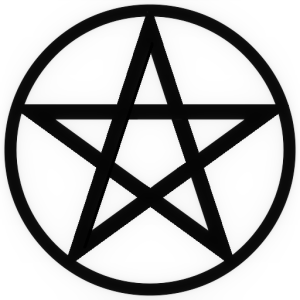
The pentagram is a five-pointed star within a circle.  Originally, the single peak was on top and pointed towards God.  It was first recorded around 3500 BC.  The Ancient Mesopotamians used it represent their power extending into the four corners of the world.

The Hebrews chose the pentagram to signify Truth, and Pythagoras’ followers considered it to be the emblem of Perfection.  Celtic Druids also associated it with the Godhead, because five was their sacred number.

The Early Christians connected the pentagram with the Five Wounds of Christ, but eventually decided to use the symbol of the Cross as their banner instead.  Yet the religious connection to the “Endless Knot” of the star endured, and it soon became a personal talisman to ward off demons.  In Medieval times it was used as an amulet over windows and doors to stop evil from entering the home.

According to Arthurian legend, Sir Gawain adopted the pentagram for the coat-of-arms on his shield, claiming the five points represented Generosity, Courtesy, Chastity, Chivalry, and Piety.

It was also used by the Knights Templar, who believed the pentagram contained certain mystical powers.  Later, when they were persecuted by King Louis IX’s Inquisition, this symbol became associated with heresy.

Before long, the five-pointed star was linked with the Horned God, Pan.  It was renamed the “Witch’s Foot” and entered in the mythology of witches and  pagans.  No longer did the pentagram represent the Divine.  For many years it was the public symbol of Satan and his devils.

In private, however, the power of the pentagram lived on. Western Occultists and Freemasons believed that mankind was a smaller part of a greater universe and they decided that this symbol – the “Star of the Microcosm” – was the best representation of human insignificance.

During the Nineteenth Century certain Metaphysical Societies – particularly those based on the ancient Holy Kabbalah – established the pentagram as part of the Tarot Card system of divination.  They renamed the Suit of Coins as the Suit of Pentacles.

Twentieth Century Satanists adopted inverted pentagrams (and inverted crucifixes) as symbols of evil – an unfortunate association that has stuck in public consciousness.

Meanwhile, the upright pentagram has been reclaimed by Wiccans and Witches.  They see it as a representation of the five elements – Earth, Fire, Wind, Air, and Spirit.   It remains the most recognized symbol of their beliefs, and has once again become associated with the Divine!

Sources:

Cyber Witchcraft. “Witchcraft Symbols,” at http://www.cyberwitchcraft.com/witchcraft-symbols.html

Pagan’s Path. “History of the Pentagram”: at http://www.paganspath.com/magik/pentacle1.htm

Wikipedia. “Pentagram,” at https://en.wikipedia.org/wiki/Pentagram

(Picture: Public Domain)

Copyright © 2022 | KitPerriman.com | All Rights Reserved

Kit’s Crit: Tell My Horse (Zora Neale Hurston)

Hurston

Do you believe in Zombies?  Having studied Voodoo in Jamaica and Haiti, Zora Neale Hurston’s book Tell My Horse (1938) claims that the undead really do exist and she has seen proof with her own eyes!

As a member of the Harlem Renaissance, Hurston was interested in recovering authentic black feminine power.  But she did not look for it in the guise of the New Woman, she wanted to reconnect with the wily, wild conjure woman from the African Ur-cultures, the pagan witches of antiquity.

Tell My Horse: Voodoo and Life in Haiti and Jamaica is divided into three parts.  The first two are a little disorganized as she describes the history and politics of Jamaica and Haiti.  Legend has it that while Hurston was doing “under cover” research in Jamaica, the natives found out she was going to publish their secrets and she had to flee the island in fear of her life.

The third section about Voodoo is both disturbing and compelling.  Hurston respectfully introduces this practice as “a religion of creation and life,” but then describes at length the “people who have been called back from the dead,” in particular “this case of Felicia Felix-Mentor . . . So I know there are Zombies in Haiti.”  But these are not the flesh-eating TV characters that appear in The Walking Dead.  Haitian Zombies are generally called back for one of three reasons: to work as free manual labor toiling in the fields; as the revenge of an enemy who wants to deny them eternal rest and peace; or as a sacrifice to another spirit.  It is the Haitian version of giving-a-soul-to-the-devil.

ZombieThe dead person’s spirit is stolen by the Bocor  who turns the body into a mindless slave.  Bocors are the “bad witches” of Voodo, as opposed to the “good witch” leaders called the Houngan. 

Tell My Horse is a strange and fascinating attempt to explain the West Indian Obeah practices.  It is weird – and at times disgusting – and definitely an acquired taste.  Scholars will find it useful, but I do not think its antiquated style holds much appeal for the general reader.

Fortunately, it is a very different book from Hurston’s other stellar work!

(Photos: Public Domian)

Copyright © 2022 | KitPerriman.com | All Rights Reserved

Doctor John Bayou: Voodoo Man

Voodoo 6

The “Last of the Voodoos” in New Orleans was the infamous tattooed Jean Montanet, commonly known as Doctor John, Voudoo John, and Bayou John.  Born a free member of the noble Bambaras Tribe from Senegal, John was kidnapped by Spanish slavers and shipped to Cuba.  After earning his freedom from a friendly master he worked as a ship’s cook, finally settling in Louisiana.

Doctor John seemed to possess mysterious Obi powers.   He began telling fortunes – and must have been skilled at reading people because he soon had enough money saved to buy a house.  Then he set up as a conjure man, and at the height of his fame was estimated to be worth $50,000.

John kept a harem of at least fifteen “wives” that he claimed to have married according to African tradition.  Most of these women were bought as slaves and they bore him many children.  At one time he teamed up with Voodoo Queen Marie Laveau to sell potions, charms, and spells.

Although Doctor John often looked after the poor in his neighborhood – and gave away food to the needy – he was tricked several times by unscrupulous business men who stole away his fortune.  He ended up broke, living with one of his daughters.

But how powerful was this Voodoo conjure man?  He seemed to have a charismatic personality and a sound understanding of herbal lore.  There are many first-hand accounts that his medicines actually worked.

However, he also liked to take advantage of the gullible white women who came to him out of curiosity.  One lady paid him $50 for a potion he later confessed was merely a few common herbs boiled in water.  His rationale was, “If folks want to give me fifty dollars, I take the fifty dollars every time!”

Sources:

“Haunted New Orleans” at http://www.nola.com/haunted/voodoo/?content/history.html

Hearn, Lafcadio.  “The Last of the Voudoos” at http://www.sacred-texts.com/afr/hearn/lastvdu.htm

New Orleans Historic Voodoo Museum

(Photo: Kit Perriman)

Copyright © 2022 | KitPerriman.com | All Rights Reserved